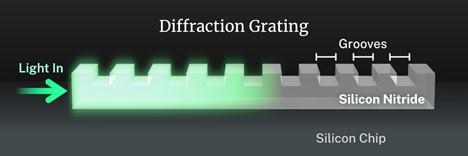
Physicists from NIST studied a miniature light-scattering system - an ultrathin layer of silicon nitride,
The researchers noticed that mostexperiments, the light behaves "as expected", and rapidly fades. However, if the width of the grooves was almost equal to the distance between them, at a certain wavelength of infrared light, its intensity decreased linearly, not exponentially. At the same time, slight changes in the wavelength or the distance between the grooves returned the system to exponential decay.
Scientists also noticed that every timethe intensity of the flux propagating along the grating changed from exponential to linear, the light scattered upward formed a wide beam with the same intensity throughout.
 Source: S. Kelley/NIST
The NIST research team neededseveral years to develop a theory that could explain the strange phenomenon. Scientists believe that it is due to a complex interaction between the lattice structure and light propagating forward and upward. Under certain conditions, at the so-called exceptional point, the combination of these factors dramatically reduces the loss of infrared light.
As the authors of the work note, furtherexperiments have shown that similar exceptional points are characteristic of any type of waves (for example, acoustic, x-ray, radio waves) propagating through a periodic structure with losses.
The researchers believe that the property they foundof light will help to transmit beams of light from one chip-based device to another without losing energy, which is useful in optical communications. And a wide vertical beam created at an exceptional point will be useful when studying a cloud of atoms.
Another potential application isenvironmental monitoring. As the authors of the work explain, if a contaminant on the surface of the sensor changes the wavelength of light in the grating, the exceptional point will abruptly disappear, and the light intensity will quickly go from linear to exponential decay.
Read more:
It has been hunted for centuries: what do we know about the planet Vulcan next to the Sun
Physicists have experimentally confirmed a new fundamental law for liquids
Astronomers have found the source of mysterious radio bursts that come from space