Aquaculture currently supplies more than half of the world's fisheries, and over the past 10 years,profit
By monitoring water quality, fish farmers canact when harmful levels of contamination are detected. However, most commercial sensors monitor only one thing at a time - the level of acidity or oxygen, and each indicator on individual devices that the farmer must manually check. Multifunctional alternatives are bulky, expensive and require an experienced operator.
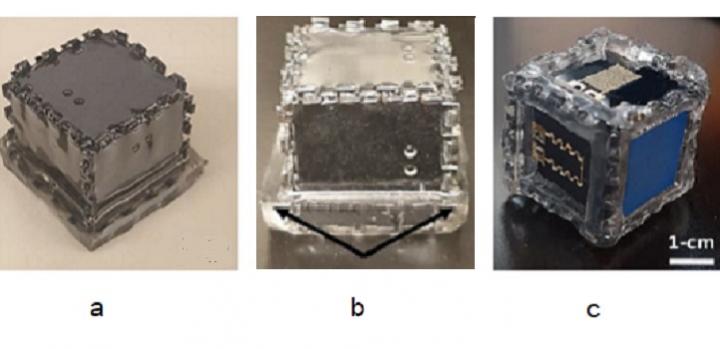 Steps to Create a Floating Multidimensionalintegrated circuit: a) MD-IC is encapsulated with a biosafety polymer, b) with an asymmetric base, to allow it to swim, but to stay on the right path up and c) with a solar cell on top and water sensors at the bottom.
Creating electronic devices that performseveral tasks at the same time, is a difficult task, and often there is a compromise between quality and quantity of functions. Electrical engineer Mohammed Hussein and his team have created a small, self-powered sensor that monitors many water quality characteristics and transmits data via Bluetooth.
Researchers have built this multi-sensorysystem using a multidimensional integrated circuit (MD-IC). The cube is designed for swimming with sensors for pH, temperature, salinity and ammonia on the downside. The shell is weighed to ensure its safety even when exposed to fish. Other external surfaces include sensors that monitor air pollution, solar cells to charge a battery sealed in a cube, and an antenna for transmitting data via Bluetooth to a mobile phone.
Integrating different functions on a single computer chip is complicated and expensive.But we've combined multiple tiles into a cube so that each face serves a different purpose.The connected chips then act as a single device.The farmer can simply drop the device into the water and it rotates in the correct position.The MD-IC concept is unique because it opens up possibilities for individual devices with IoT applications.And water is always an intriguing medium for electronics
Nazek El-Atab, one of the authors of the device.
Preventing unnecessary fish death isan important step towards food security. Saudi Arabia is investing $ 3.5 billion in aquaculture so that by 2030 it can produce 600,000 tons of seafood per year. The team hopes that their sensors will support this goal, but also believes that small cubes can have a great future outside of fisheries. For example, they can be sent via pipelines to collect data on oil quality. Researchers are working to improve the device’s self-cooling technology to prevent it from overheating, and the next step will be to test it in the field.