Failed Apple III
Apple's very first computer, the 1976 Apple I, was something of an experimental
Apple III's launch was accompanied by huge advertisingcampaign, and all work on the Apple II was closed, and resources were transferred to a new project. Alas, it quickly became clear that Apple IIIs were breaking due to overheating, excessive component density, and poor connectors. The reason for the failure of the product was also the fact that there was no high-quality software for the new computer yet, and in Apple II mode, the machine cannot be fully used, because the developers blocked the connection of external boards. The computer, of course, was finalized, but Apple's reputation was damaged, and in 1983 the IBM PC came out on top in terms of sales, and the Apple III was discontinued in 1984.
Newton MessagePad
Ahead of its time, both in concept and probably in execution, the Newton MessagePad was the epic project of John Scully, the man who ousted Steve Jobs from Apple in 1985.
The device was launched in 1993, andNewton MessagePad was positioned as PAD (Personal Digital Assistant), which involuntarily makes us think of today's smartphones and the iPhone itself. Designed to analyze and correctly interpret the user's personal information, Newton MessagePad was supposed to help with the organization of life.
Unfortunately Newton was completely misunderstoodcontemporaries, and its perfectly crooked handwriting recognition system turned the device into an outright laughing stock. The result was the immediate "destruction" of this product after the return of Steve Jobs in 1997.
Mac OS Copland operating system
1987, three years after the launch of the Mac,a group of engineers responsible for the software decided to slightly update the computer's operating system, equipping it with memory protection and preferential multitasking.
New object-oriented operating roomthe system with the familiar interface from the Mac and with an increased computing base was named Pink. The project was soon redesigned, following a 1989 deal between Apple and IBM that resulted in an independent operating system called Taligent. Of course, it was the same Pink, only with a different name.
In 1993, Apple's new management decides to startcreating another OS with a Mac-like interface, but working on any architecture. The main goal was to present a viable competitor to the upcoming release of Windows 95. The project was named Raptor. The system was supposed to provide Apple with the next generation microkernel, and therefore the company focused entirely on it.
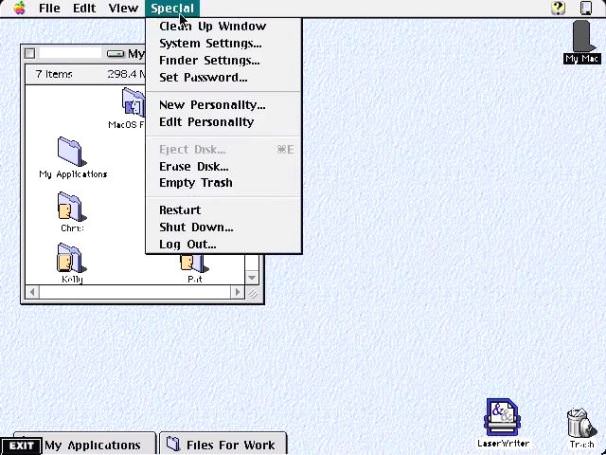
But unfortunately the idea was killed by poor management andconflict within the team. However, the management was not going to deviate from the original idea, and therefore a new group of engineers was assembled, and already in 1994 work began on Copland. Three months later, the public became aware of it, and in May 1995, Apple announced a release the following year, along with Mac OS 8.
Within nine months from the start of workthe operating system has changed beyond recognition. The idea behind Raptor was to build a core and add new features all the time. Apple wanted not only to provide the audience with a product, but to effectively develop it. Copland started to implement the strategy, but quickly got bogged down in trying to cover everything at once. The original 4 people in the development team transformed into 100 in less than a year.
When the team in charge of the system was unable to provide a public beta in May 1996, CEO Gil Amelio realized that the company needed to look for an alternative.
Until now, the Mac fan community remainsa question related to the need at that time to buy BeOS from Be or Open Step from NeXT. But almost no one seriously mentions Copland. Despite the technicalities, it was important for the next Mac OS to get a new face. Apple needed not just a step forward, but a leap forward that would speak of the pursuit of modern technology. Amelio's decision most likely saved the company, because Apple would not have become itself without abandoning Copland.
PowerBook 5300
Apple's PowerBook series of notebooks receivedgreat success back in the early 90s. The PowerBook 5300 had tremendous potential to take the line's popularity to a whole new level. Released in 1995, the 5300 was sort of the ultrabook of the day. Yes, it didn't have an optical drive, but it did come with a floppy drive for 3.5-inch floppy disks. It was also the first laptop from Apple to use Motorola's new PowerPC processor.
But, unfortunately, things did not go from the very beginningSo. Multiple casing problems caused cracks on the lid of the laptop, and flaws in the hardware greatly affected the display's performance. Worse, most laptops quickly overheat and could even catch fire, which gave the PowerBook 5300 the “HindenBook” name and a hard-hitting history.
iTunes made users listen to U2
500 million people from 119 countries received“gift” from Apple. The album Songs of Innocence by the Irish rock band will be available for free, Apple CEO Tim Cook announced after the musicians performed at the presentation of the new iPhone.
However, instead of just making the album free to download, Apple added it to everyone's iTunes library.
Thus, 11 songs from Songs of Innocenceby themselves appeared in the album list. Not everyone was pleased with such a forced gift. On social networks, many were outraged that they did not like the U2 group and would never download the album themselves, and now they cannot delete it. At the same time, the majority of users were rather unhappy with such an unceremonious interference with their media library. Although this is allowed by the user agreement.
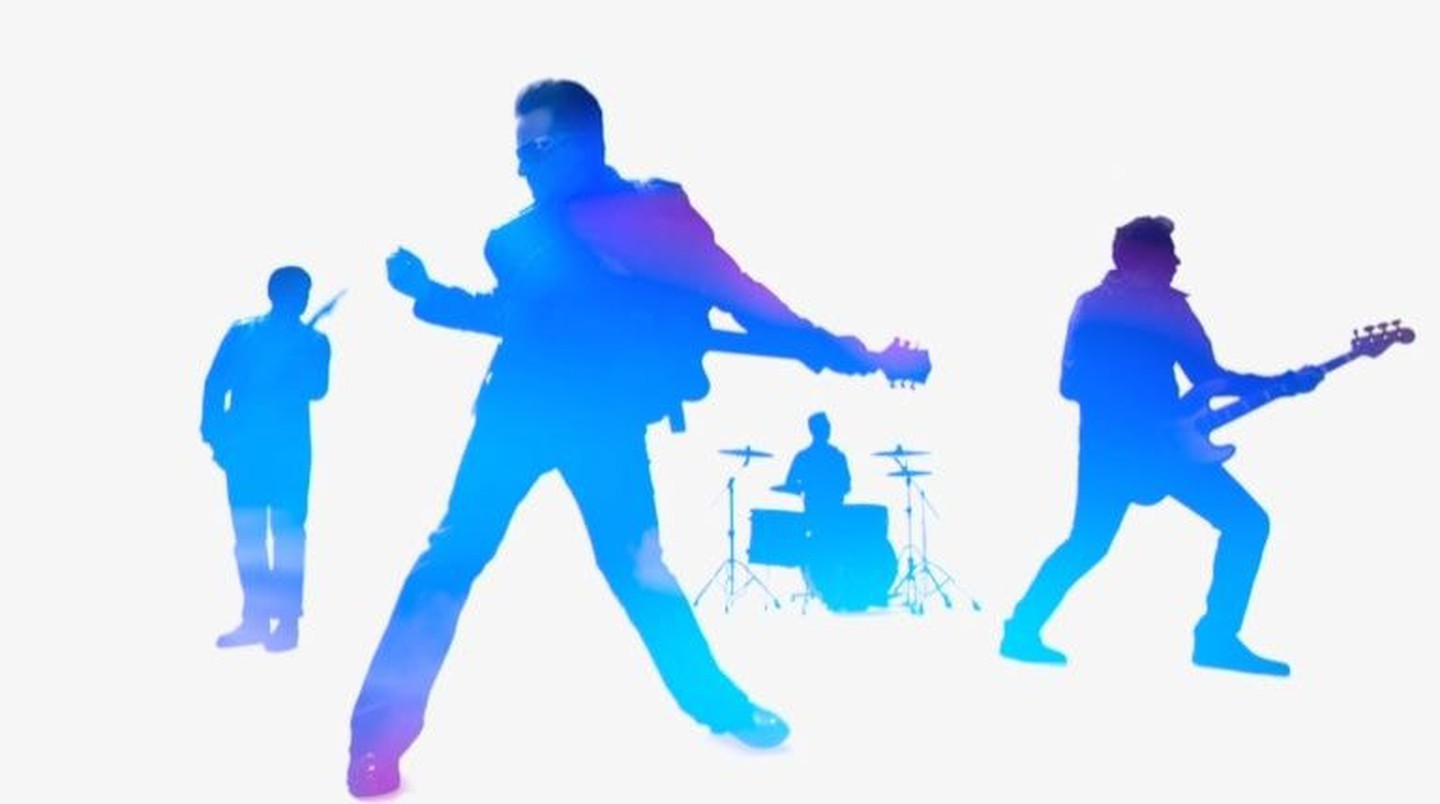
“I thought I had a good antivirus program, but this U2 album is still in my iTunes,” wrote one Twitter user.
“I find it offensive that Apple added the U2 album to the cloud for me without asking. So wake up in the morning, and you have Justin Bieber in your music library, ”writes another.
Almost immediately people began looking for instructions,how to get rid of an unwanted album. However, the company soon responded to user dissatisfaction by creating a special page to remove Songs of Innocence. As a result, Apple support created a special page with instructions on how to delete a U2 album that was forcefully downloaded to every iPhone and iPad.
Antenna issue in iPhone 4
A prime example of how a failedThe PR campaign is compounded by the arrogance of Apple's management. Shortly after the launch of the iPhone 4 in June 2010, it was revealed that the antenna (and reception) of the phone, which was built into the top, bottom, and sides of the device, was blocked from time to time. By whom? People, or rather, their fingers.
Instead of admitting an obvious flaw,Steve Jobs simply accused iPhone owners of "holding them the wrong way." The scandalous headline spread all over the world, and on the Internet caused a wave of laughter and indignation at the same time.
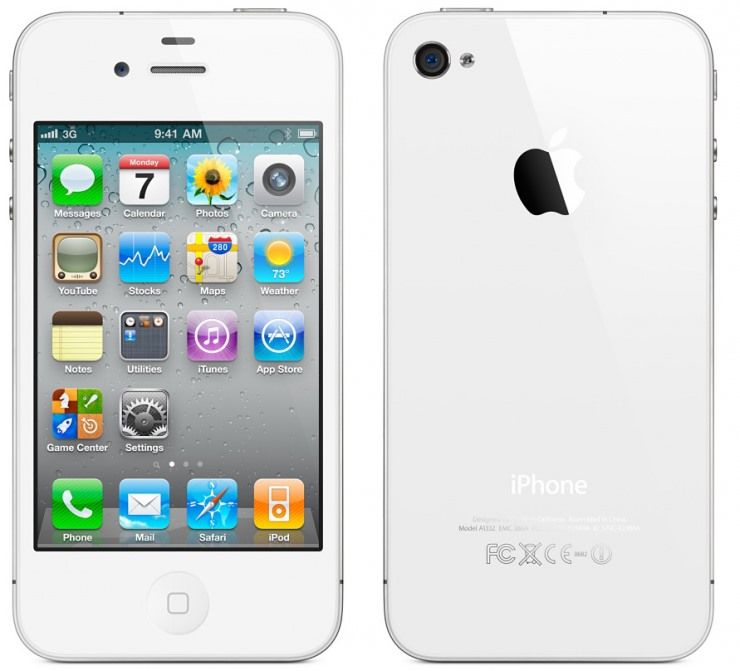
In the end, Apple solved this problem,spending several million dollars to create an addition to the body - silicone bumpers. A small amount for such a large corporation, but a great lesson in leadership. If the bundle had originally included Bumper, then there would have been much less controversy and discussion.
Slow iPhone
The investigation against Apple began in 2017.Users had noticed slowdowns in older iPhones before, but then the general outrage prompted the states, led by Arizona, Arkansas and Indiana to study whether the company deliberately reduces the performance of older devices. The reason for the investigation was the suspicion that in this way Apple is persuading its users to buy new iPhone models.
Smartphone owners stated thatDevice performance has noticeably decreased after installing iOS 10.2.1. Users filed lawsuits against Apple, claiming that the company misled them about the condition of the gadgets.
In December 2017, the company admitted thatreally underestimated the clock speeds of the processors of older smartphones. According to Apple representatives, in this way the company protected iPhone owners from sudden shutdowns and other malfunctions, and also increased battery life. The company claimed that iOS 10.2.1 released an algorithm that slows down the speed of the gadget depending on the state of the battery.
In March 2020, it became known that Applewill pay compensation to smartphone owners in the amount of up to $ 500 million. The company denied accusations that its actions were aimed at encouraging the purchase of new iPhone models, but agreed to pay compensation to avoid litigation. US owners of iPhone 6, 6 Plus, 6s, 6s Plus, 7, 7Plus and SE who installed iOS 10.2.1 or later on devices could qualify for $ 25. And a month earlier, in February, Apple was fined by the French authorities - the company had to pay € 25 million for the deliberate slowdown of old iPhones.
Read more
The first accurate map of the world was created. What's wrong with everyone else?
The most stormy place on Earth: why Drake Passage is the most dangerous route to Antarctica
New uranium compound breaks record for anomalous conductivity