T-shirt for avatar
The founder of digital fashion in its modern sense is considered to be Kat Taylor,
But in a broader sense, digital clothinghas been around for much longer, and fans of video games know most about it, especially in the RPG/MMORPG genres (offline role-playing and massive online role-playing games). Most often, one of the main mechanics of such games is dressing up: the character can wear certain things that are freely available in the game world, sold from in-game merchants, “looted” from ordinary enemies and bosses, or sold by real players at auctions in the game world. The things themselves differ not only in appearance, but also in the list of bonuses for various attributes, which in general logically change the characteristics of the characters. For example, heavy thick armor obviously increases defense, but reduces stamina, and a beautiful silk dress has a positive effect on the perception of the character by others, increasing his charisma.
In some games, clothing only affects appearance.type of character and does not give him any other bonuses. But at the same time, even such clothes cost money: for example, back in the middle of the 2000s, after the release of the Sims 2 life simulator, various add-ons came out to the game every now and then, including new clothes - discs with them were sold in video game stores.
 “In some games, clothes only affect the appearance of the character and do not give him any other bonuses”
Nowadays such things are sold in metaverses, and inYou can dress up your avatar with them. Moreover, this form of selling digital clothing has two directions: existing brands that bring their collections to the digital content market, and brands that are born within the metaverses themselves. For example, the Moon Miner collection appeared in the Decentraland universe - one of the first approved by the creators of the digital world. Subsequently, her things gained recognition and migrated to other metaverses, for example Sandbox.
But there is also a more functional digitalclothes - some items even help you earn real money. For example, in the STEPN application, a user can buy virtual NFT sneakers. By “wearing” them for a run (in essence, the phone simply counts steps), the user receives Green Satoshi tokens as a reward, which can be exchanged for other cryptocurrencies and even real money. But like all digital assets, Green Satoshi is extremely volatile - at the end of April it was worth almost $8 per coin, and now it is about $0.25.
Applause for the designer
In principle, the creation of virtual clothes cananyone can do it, but big brands still clearly occupy the largest share of this market, as in real life. The Virtue agency was one of the first to launch its collection, promoting the Scandinavian online store Carlings. Similarly, the Dutch The Fabricant released a set of pieces, including a jumpsuit dress created by the joint efforts of artist Joanna Jaskowski and Dapper Labs. It was sold in the blockchain game CryptoKitties (one of the first gaming NFT projects) for $9.5 thousand real money.
There are also things from more famous brands:for metaverse avatars, sneakers very similar to the Nike Air Force were sold at different times at a price of $ 3.1 million for three pairs. And a virtual Gucci handbag was once sold for $4,000 — more expensive than its real counterpart. For such purchases, there are already entire marketplaces like replicant.fasion or Metawear.
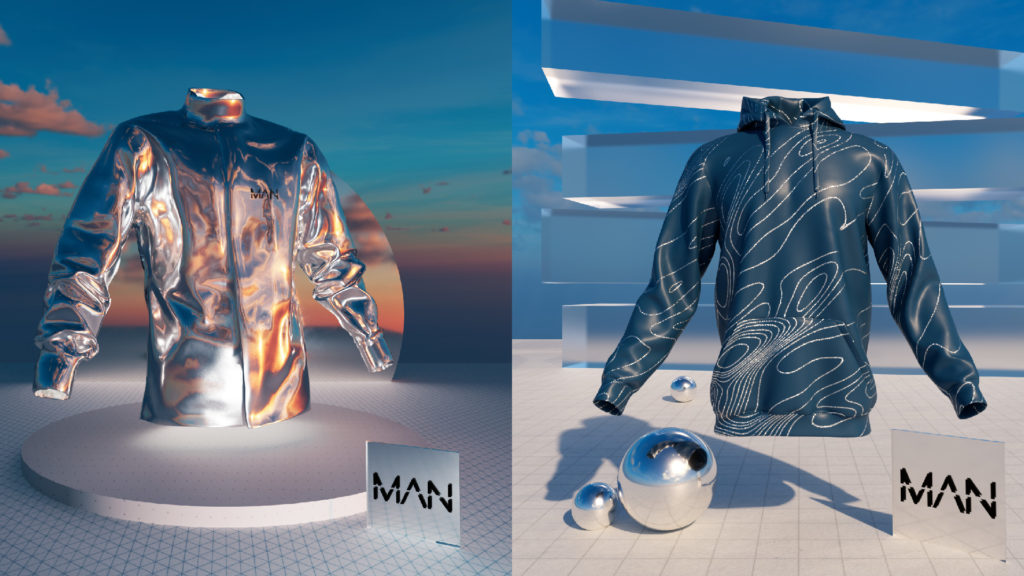 “Anyone can create virtual clothing, but the big brands are clearly holding the largest share of this market so far”
In Russia, the first digital clothing designerRegina Turbina, the founder of the Ophelica brand, is considered to be the founder of the Ophelica brand - in March 2020, she released a set of clothes from a sweatshirt and trousers, which was sold to one of the media directors of Yandex for 5 thousand rubles. At the same time, the girl herself produces things in the real world - she sews them from natural fabrics like linen, velvet, silk and cotton. You can read more about her and her work here.
Following her, digital clothing in Russia begando other designers. For example, Ilyas Darakcheev created the ISDKV virtual sneaker brand, Tatiana Rumyantseva founded the Kai Kai virtual clothing brand, and Maria Shevchenko founded the first online school in Russia to study 3D clothing design. Maria publicly shared her experience of creating collections in 3D at TECH IN FASHION, which was held at the VDNKh Robot Station with the support of the Moscow Innovation Agency.
Virtual dress - virtual closet
Leaving aside purely game elements,The rise of digital clothing came during the pandemic, when people around the world stayed at home and made more and more posts on social networks. Then many bloggers paid attention to the fact that a particular bow, in principle, is purchased once or twice, after which it is sent to the closet and is never used again. And given that, in parallel with the pandemic, the topics of ESG and sustainable development have entered the global information agenda, the environmental friendliness of this approach to buying things has become, to put it mildly, very dissonant with the general trend.
It was at this point that digital clothing becamerapidly gain popularity. Why buy real things, while creating an additional load on the logistics infrastructure, if you can “put on” the dress or jumper you like just to record a couple of stories on Instagram?
A similar practice literally saved manymanufacturers of real clothes: they no longer had to make complex calculations and sales forecasts for the next collections. For example, the Russian company Malivar, which is engaged in the promotion of influencers and also the production of digital clothing, has introduced the following practice: the designer creates a digital look, which was shown on the digital model Alena Pole. Users who liked the digital version could pre-order, after which the designer produced exactly the number of clothes in a certain size that was in demand by the public. As a bonus, the cost of real materials, which are usually used to create prototypes of new things, was reduced - this approach is generally more environmentally friendly.
What will happen next
To the greatest extent the future of digital clothingdefinitely related to the growth in the number of metaverse users and their corresponding spending. According to recent forecasts, by 2030 these costs will grow to $ 5 trillion, and by 2026, a quarter of the entire population of the planet will spend at least an hour a day in the metaverses.
However, such things are already turning intoinvestment tools and allow you to save or increase capital in the same way as rare bags like the most expensive Hermes Diamon Himalaya Birkin 25 in the world for $ 300 thousand leave auctions. It is likely that unique digital items in the future will be sold even more expensive than real ones, especially if a beautiful legend will be sold with it. Just imagine how much a virtual NFT accessory of the Off White brand could cost if it was the last creation of the cult brand founder Virgil Abloh.
Read more:
Look at the celestial "Titanic" that will run on nuclear power
NASA figured out how to look for life on Mars: the experiment showed where it could be
Astronomers have found planets that are different from Earth, but suitable for life