Researchers from the University of Minnesota studied the properties of a tiny galaxy that formed around
The explored galaxy is one of the mostthe smallest ever found at such a great distance. The researchers were able to find and study it using gravitational lensing. This is a phenomenon that occurs under the influence of gravity: the mass in a galaxy or a cluster of galaxies bends and amplifies light from distant objects. The Galaxy Cluster Lens made this small background galaxy appear 20 times brighter.
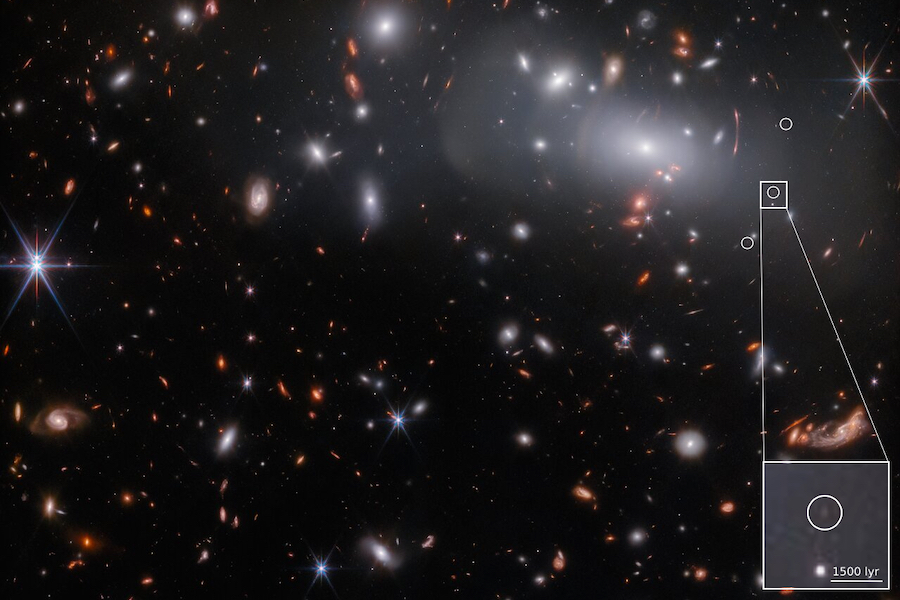 A tiny galaxy as seen by the James Webb Telescope. Image: ESA/Webb, NASA & CSA, P. Kelly.
Astrophysicists have used spectroscopy tomeasure how far away a galaxy is and determine some of its physical and chemical properties. The study showed that the redshift is 9.51, which corresponds to 510 million years after the Big Bang. At the same time, its radius is about 16.2 parsecs (53 light years), and the luminosity corresponds to closer galaxies (with a redshift of 6 to 8). This indicates a high density of the star formation rate.
Galaxies that existed when the universewas in its infancy, very different from what we see in the neighboring universe now. This discovery could help us learn more about the characteristics of these first galaxies, how they differ from neighboring galaxies, and how they formed.
Hayley Williams, study co-author
Researchers note that "James Webb" maycollect about 10 times more light than Hubble. In addition, it is much more sensitive to longer wavelengths in the infrared spectrum. This allows scientists to access new data about the early universe and better understand its evolution.
Read more:
Scientists have studied an ultra-bright object that violates the law of physics
"Sea" of quarks inside one proton: what does an elementary particle consist of
Look at the highest resolution map of Mars: 110,000 frames and 5.7 trillion pixels