Planetary scientists from Johns Hopkins University in Laurel used the capabilities of the James Webb Telescope,
The researchers used satellite data toExoplanet Transit Survey (TESS) to select a target for the study. This satellite has discovered that a planet may be orbiting the star LHS 475. This red dwarf is located 41 light-years from Earth in the constellation Octans and shines about half as brightly as the Sun.
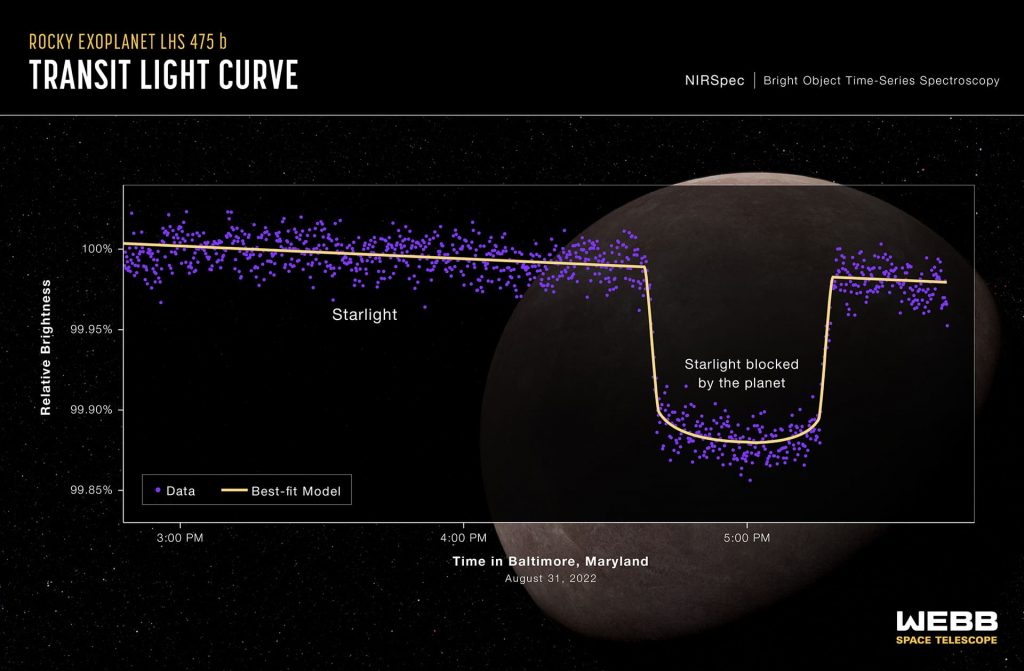 An exoplanet transiting the disk of LHS 475. Image: NASA, ESA, CSA, Leah Hustak (STScI)
Exploring this star system withThe James Webb telescope confirmed the transit of the planet across the disk of the star. This method is widely used to identify exoplanets: when an object passes between a telescope and a star, an “eclipse” occurs, during which the planet blocks part of the light. Periodic changes in the amount of light recorded by the telescope confirm that the changes are caused by the rotation of the planet in its orbit.
Researchers used data collectedWebb spectrograph to see if this planet has an atmosphere. Although the results of the first measurements indicate that this is a terrestrial planet, it has not yet been possible to accurately answer this question. Planetologists have found that LHS 475 b definitely cannot have the methane atmosphere that is observed on Saturn's moon Titan.
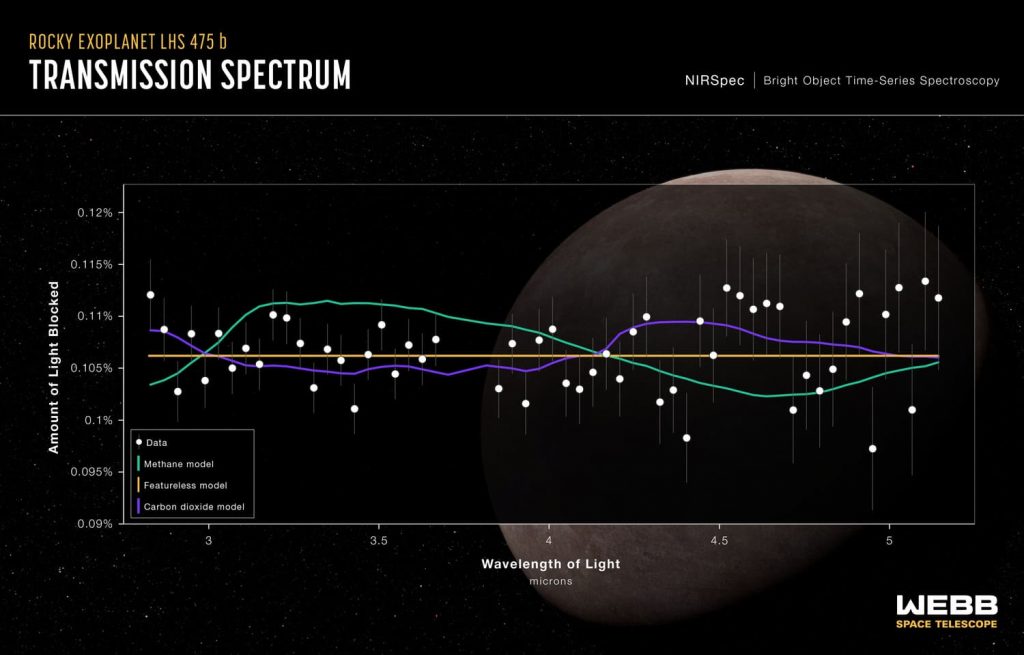 Spectrograph observation data (white dots) andmodeling of atmospheres of different types: methane (green line), carbon (purple line) and a planet without an atmosphere (yellow line). The observational data best fit a planet without an atmosphere, but current measurement uncertainties are also consistent with a carbon dioxide atmosphere. Image: NASA, ESA, CSA, Leah Hustak (STScI)
At the same time, Webb also showed that LHS 475 b onseveral hundred degrees warmer than Earth, so if clouds are detected, this could lead researchers to conclude that the planet is more like Venus. Its atmosphere consists of carbon dioxide and is constantly shrouded in thick clouds. Scientists plan to collect additional data on the spectrum of light in the process of observing the planet in 2023.
Read more:
The strongest class X flare occurred on the Sun
Engineers figured out how to keep drones in the air "forever"
The secret of the durability of Roman concrete is revealed: it can be restored
On the cover: an artistic illustration of the red dwarf exoplanet LHS 475 b. Image: NASA, ESA, CSA, Leah Hustak (STScI)