Using the James Webb Space Telescope (JWST), an international team of astronomers has discovered a new
The discovery was made using the James Webb Near Infrared Camera (NIRCam) as part of the JADES Extended Deep Extragalactic Survey.
JADES-GS+53.15508-27.80178 was first identified in 2010 (then it was called differently). New NIRCam data shows it to be a resting galaxy that experienced a brief and intense burst of star formation, followed by a lull, about 10 to 20 million years ago.
In particular, the study showed that the speedstar formation JADES-GS+53.15508-27.80178 increased significantly about 80 Myr ago. This went on for about 50 million years, and then the galaxy went out in a short time. At the same time, JADES-GS+53.15508-27.80178 appeared when the Universe was only 700 million years old.
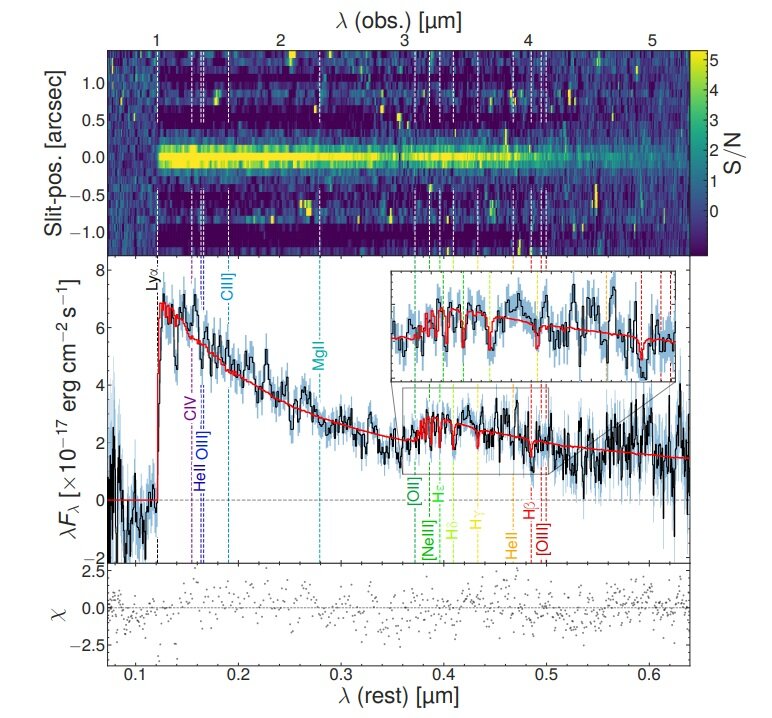 Spectrum NIRSpec JADES-GS-z7-01-QU.
Image Credit & Copyright: Loser et al., 2023
Many massive galaxies are in a staterest, so even at high redshift they have almost no signs of ongoing star formation. They are also known to be physically compact. To date, astronomers have found very few spectroscopically confirmed high-redshift galaxies (up to 5.0) at rest. The search for new objects of this type is of great importance for scientists, as these objects help to learn more about the early stages of the evolution of the universe.
Read more:
A treasure with 1,000 coins was accidentally found on a farm: what could they buy
Named a vitamin that protects the brain from dementia
It turned out which men are the most fertile: their sperm is 50% better than the rest
Cover photo: Fornax galaxy, ESO