The James Webb mission aimed the telescope's highly sensitive instruments at the atmosphere
WASP-39b opened in February 2011 as part ofWASP project. It is notable for the fact that its atmosphere contains a significant amount of water. The latest data has told scientists what its clouds look like - torn, and not like a uniform blanket over the planet.
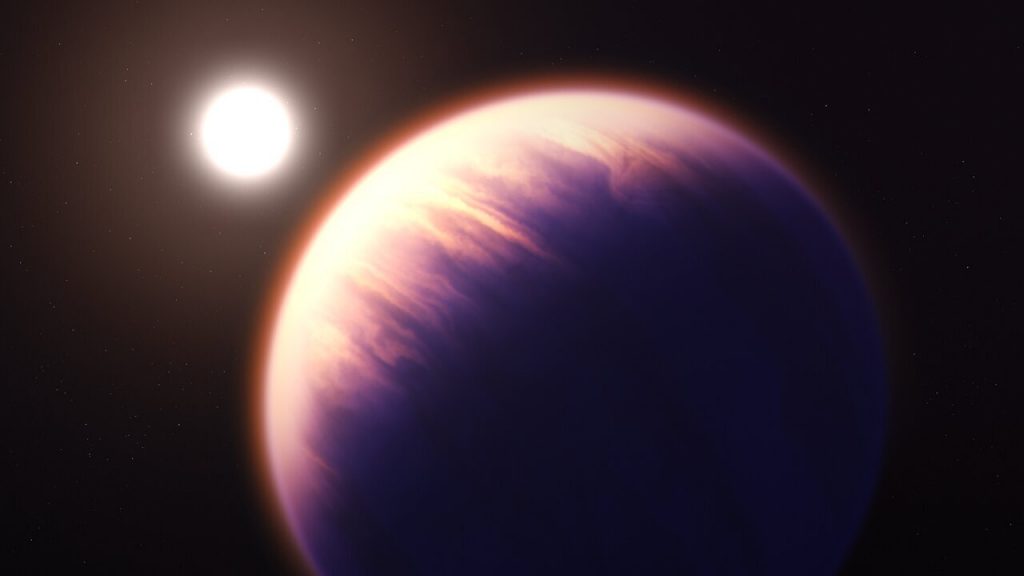 Artist's impression of WASP-39 b. Credit: NASA, ESA, CSA, J. Olmsted (STScI)
All of Webb's discoveries are described in detailin a set of five recently submitted scientific papers available on the preprint site arXiv. Among the unprecedented discoveries is the first detection of sulfur dioxide in the atmosphere of an exoplanet. This is a molecule produced as a result of chemical reactions caused by high-energy light from the planet's parent star. A protective ozone layer is created on Earth in a similar way.
"Unexpected detection of sulfur dioxideconfirms that photochemistry shapes the climate of hot Saturns, explains Diana Powell, an astronomer at NASA's Center for Astrophysics. “Earth’s climate is also shaped by photochemistry, so our planet has much more in common with exoplanets of this type than we previously thought.”
Research articles:
- Shang-Ming Tsai et al., Direct Evidence of Photochemistry in an Exoplanet Atmosphere, arXiv (2022). doi.org/10.48550/arXiv.2211.10490
- Lily Alderson et al., Early release of exoplanet WASP-39b data from JWST NIRSpec G395H, arXiv (2022). doi.org/10.48550/arXiv.2211.10488
- Z. Rustamkulov et al., Early exploration of exoplanet WASP-39b with JWST NIRSpec PRISM, arXiv (2022). doi.org/10.48550/arXiv.2211.10487
- Eva-Maria Arer et al., Early exploration of exoplanet WASP-39b with JWST NIRCam, arXiv (2022). doi.org/10.48550/arXiv.2211.10489
- Adina D. Feinstein et al., Early exploration of exoplanet WASP-39b with JWST NIRISS, arXiv (2022). doi.org/10.48550/arXiv.2211.10493
Read more:
A magnetic storm is about to hit Earth
Created a navigation system that is more accurate than GPS
An ancient amulet rewrote the history of Europe's most mysterious language