The James Webb Space Telescope has captured the most detailed image of the star WR 124, which belongs to
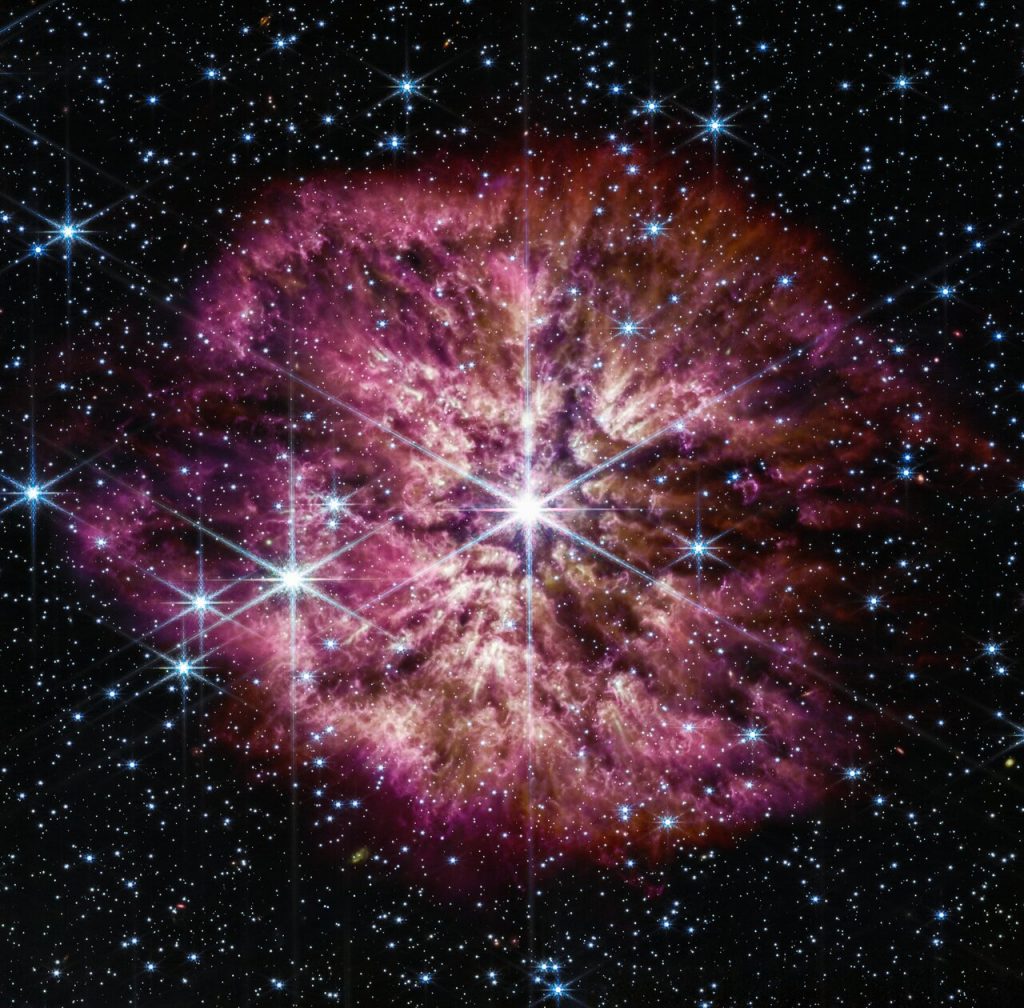 Composite image of WR 124 and its surrounding nebula taken by various instruments of the Webb telescope. Image: NASA, ESA, CSA, STScI, Webb ERO Production Team
WR 124 is located at a distance of about 15 thousand km.light years in the constellation Sagittarius. This star is about 30 times more massive than the Sun, and after the transition to the last stage of evolution, the completion of the hydrogen cycle and the beginning of the helium cycle, it shed a stellar shell, the mass of which is approximately equal to 10 solar. The ejected material formed a nebula around the star.
A halo of gas characteristic of Wolf-Rayet starsand dust surrounds the star and glows in infrared light in a space telescope image. Cold cosmic dust glows in the long mid-infrared, showing the structure of the nebula surrounding the star. The 10 light-year wide object is composed of material ejected by WR 124 and dust generated by the resulting turbulence.
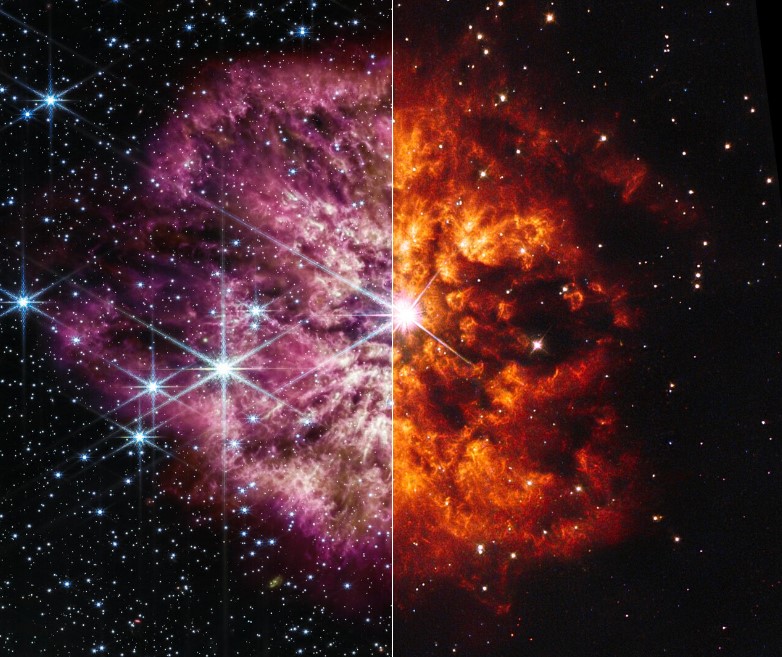 Nebula WR 124 as seen by Webb (left) and Hubble (right). Image: NASA, ESA, CSA, STScI, ESA/Hubble, Webb ERO Production Team
Massive stars develop and burn out quickly.Only a few of them go through a short Wolf-Rayet phase. This bright stage of mass loss precedes a supernova explosion, when nuclear fusion in the star's core stops and gravitational pressure causes it to collapse and then explode.
Observations of the star WR 124. Video: NASA, ESA, CSA, STScI, Webb ERO Production Team, DSS, N. Bartmann (ESA/Webb), E. Slawik, N. Risinger, D. de Martin (ESA/Webb), M. Zamani (ESA/Webb)
Stars such as WR 124 serve as an analogue,helping astronomers understand a crucial period in the early history of the universe. Such dying stars seeded the young Universe with heavy elements formed in their cores and during the explosion in the later stages of evolution. The analysis of such stars will help to understand how cosmic dust is formed and distributed, consisting of heavy elements that make up the modern Universe and living organisms on Earth.
Read more:
2,700-year-old temple found in Sudan He surprised scientists
The oldest reference to the god Odin has been found. It "hid" in a golden treasure
Biochemists have identified the most likely substance that "launched" life on Earth