Records collected in the icy Arctic waters off Canada during the winter of 2018-2019 showed that the population
Scientists believe that this behavior - earliernever seen - caused by the effects of climate change. Scientists also consider this a potential harbinger of changes in dynamics in the ecosystem of the region.
Usually from 17 to 20 thousand.individuals that make up the Bering-Chukchi-Beaufort (BCB) population have a fairly predictable migration pattern spanning 6,000 km. They spend the winter in the part of the Bering Sea that lies between Russia and Alaska, head north in the summer, then east to the Beaufort Sea and Amundsen Gulf of Canada, and return in the fall.
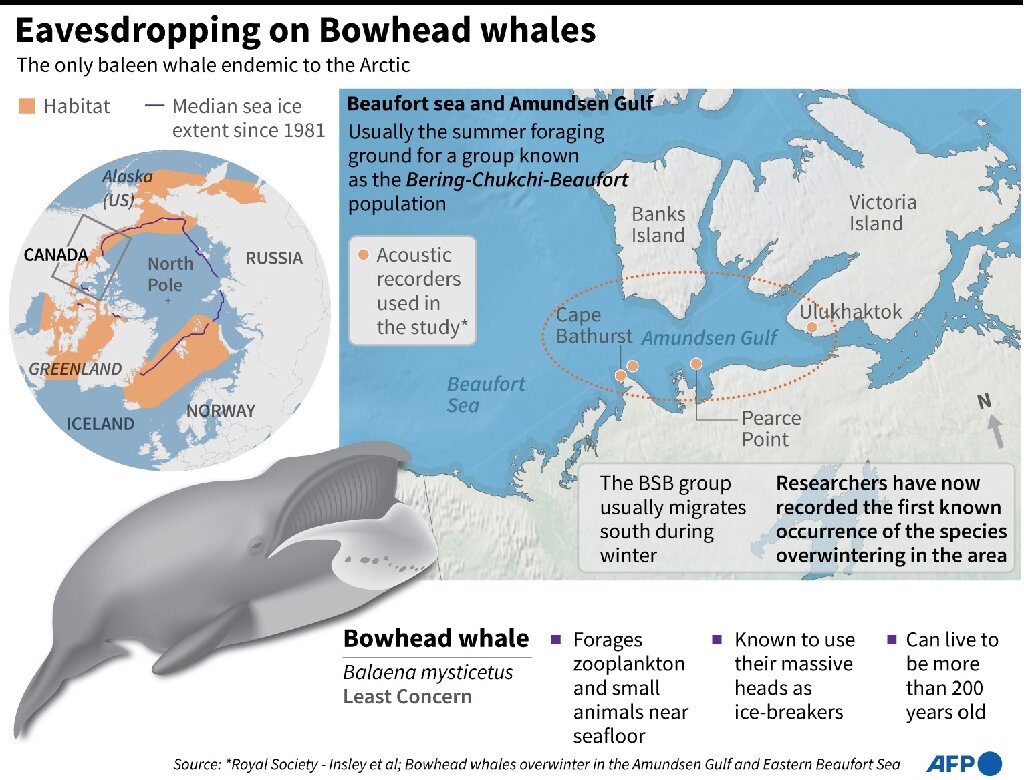 Image of bowhead whales, the only endemic whale species in the Arctic.
But in the winter of 2018-2019, the situation has changed.Residents of the Canadian region reported seeing Greenlanders at a time when they should have been in the south. A team of scientists decided to examine the sounds recorded by underwater devices scattered throughout the region to regularly collect data and listen to whales singing. The observations of local residents were confirmed. It turned out that the characteristic songs of bowhead whales, which should have been already in the southern winter territories at that time, remained in place.
“The evidence is clear that the Greenlanders hibernatedin the summer feeding area in the eastern part of the Beaufort Sea and in Amundsen Gulf in the winter of 2018-2019. And, to our knowledge, this is the first time this has been reported,” says an article in the journal Royal Society Open Science.
However, it is not entirely clear why this happened. The authors put forward various theories, mainly related to climate change.
One of the possible factors could be the displacement of the ice cover, when there was much less ice in the summer areas in the winter season 2018-2019 than usual.
Another possible explanation is “avoidancepredators." Bowhead whales are staying away from killer whales, which are increasingly being seen in some unusual habitats. The fact is that warming seas lead to a decrease in ice cover and an expansion of their habitat.
Read more
Ingenuity helicopter successfully takes off on Mars
The first accurate map of the world was created. What's wrong with everyone else?
NASA told how they will deliver samples of Mars to Earth
Bering-Chukchi-Beaufort (BCB) population