Types of black holes
There are four types of black holes based on their mass: stellar, intermediate,
Stellar-mass black holes are small but deadly
The Milky Way contains about one hundred million blackholes that were formed as a result of the collapse of very massive stars. Each of these stellar black holes weighs about 10 times our Sun. Very few of these black holes are in close proximity to an ordinary star that slowly spills over into a black hole. When this gas falls towards the black hole, it is heated by strong gravity and friction. Near a black hole, gas reaches a typical temperature of 10 million degrees Celsius. These X-ray sources from black holes are easy to observe throughout the Milky Way, as well as in nearby galaxies, using orbiting X-ray observatories.
It is noteworthy that any black hole completelyis described by just two numbers that determine its mass and rotation speed. We do not know anything simpler than an elementary particle such as an electron. Scientists at CFA have measured both of these fundamental parameters - mass and spin - for more than a dozen stellar black holes, studying all aspects of these black holes and their systems.
Despite its ubiquity in the universe,black holes remain extremely mysterious objects. We need a theory of quantum gravity that will combine Einstein's 1916 theory of relativity with 1926's theory of quantum mechanics. Such a theory does not exist, despite decades of theoretical efforts by physicists studying string theory and others. The creation of the theory of quantum gravity will become the crown of physics on a par with the achievements of Newton, Einstein and other giants.
Medium Mass Black Hole (IMBH) - Stuck in the middle
Between classes of stellar magnitude black holesAnd supermassive there must be one more intermediate. In any case, according to the laws of logic. Shouldn't there be medium-sized black holes that make the difference between stellar-mass black holes and supermassive black holes? These cosmic average masses, which can range from about 100 to 1 million solar masses—though the exact range varies depending on who you ask—are called Intermediate-mass black holes holes, IMBHs). And although astronomers have found several compelling candidates for IMBH scattered throughout the Universe, the question of whether they actually exist is still unresolved. However, evidence begins to accumulate.
Although definitive proof of existenceIMBH remains elusive, with a number of studies over the past few decades uncovering intriguing evidence hinting at the existence of these not very large, not very small black holes.
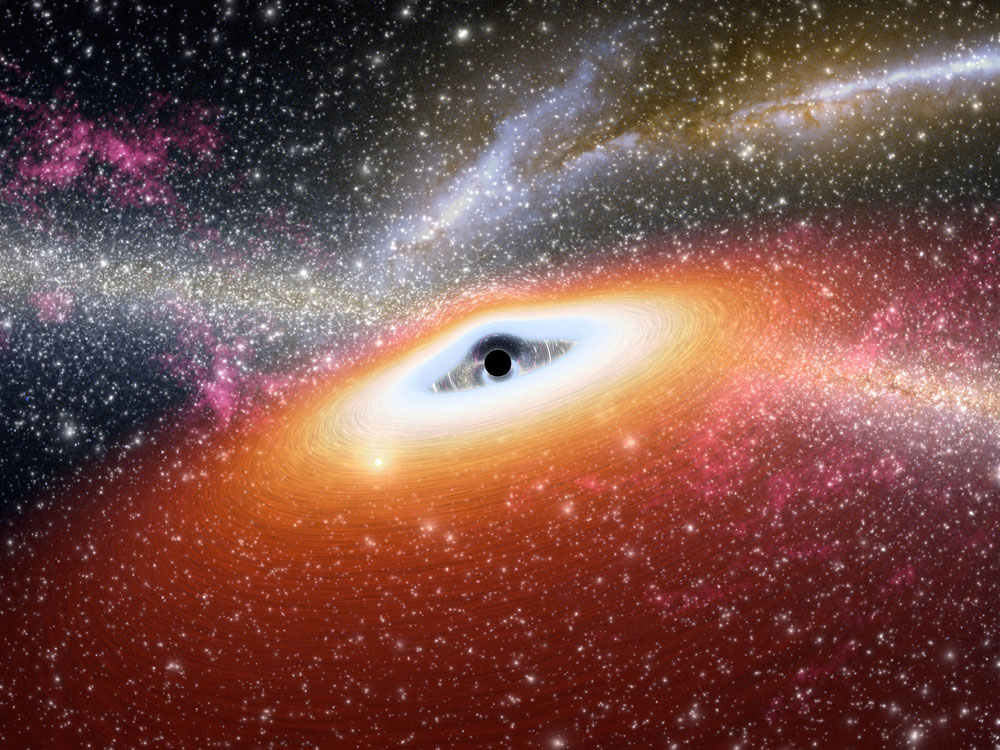 An illustration of a young black hole, such as two distant dustless quasars recently discovered by the Spitzer Space Telescope. (Image courtesy of NASA / JPL-Caltech)
For example, in 2003, researchers usedESA's XMM-Newton Space Observatory to identify two strong, distinct X-ray sources in the nearby starburst galaxy NGC 1313. Because black holes tend to violently devour material that comes too close and spews high. -energy radiation, they are among the strongest known sources of X-ray radiation. By identifying the sources of X-rays in NGC 1313 and studying how they flare up periodically, in 2015, researchers were able to limit the mass of one of the supposed black holes of the galaxy known as NGC 1313 X-1. They calculated that this is about 5,000 times the mass of the Sun, give or take, which surely puts it in the mass range of an intermediate-mass black hole.
Similarly, in 2009, researchers discoveredeven stronger evidence for the existence of a medium-sized black hole. Located approximately 290 million light-years from the edge of galaxy ESO 243-49, the team observed an incredibly bright X-ray source called HLX-1 (Hyper-Luminous X-ray source 1), which has no optical counterpart. This suggests that the observed object is not just a star or galaxy. Additionally, the researchers found that HLX-1's X-ray signature changed over time, suggesting that the black hole gets brighter each time a nearby star gets closer to it, feeding gas and causing short bursts of X-rays that then slowly fade away. away. Based on the brightness of the observed flares, the researchers calculated the black hole's minimum mass to be about 500 times the mass of the Sun, although some estimates put its weight closer to 20,000 solar masses.
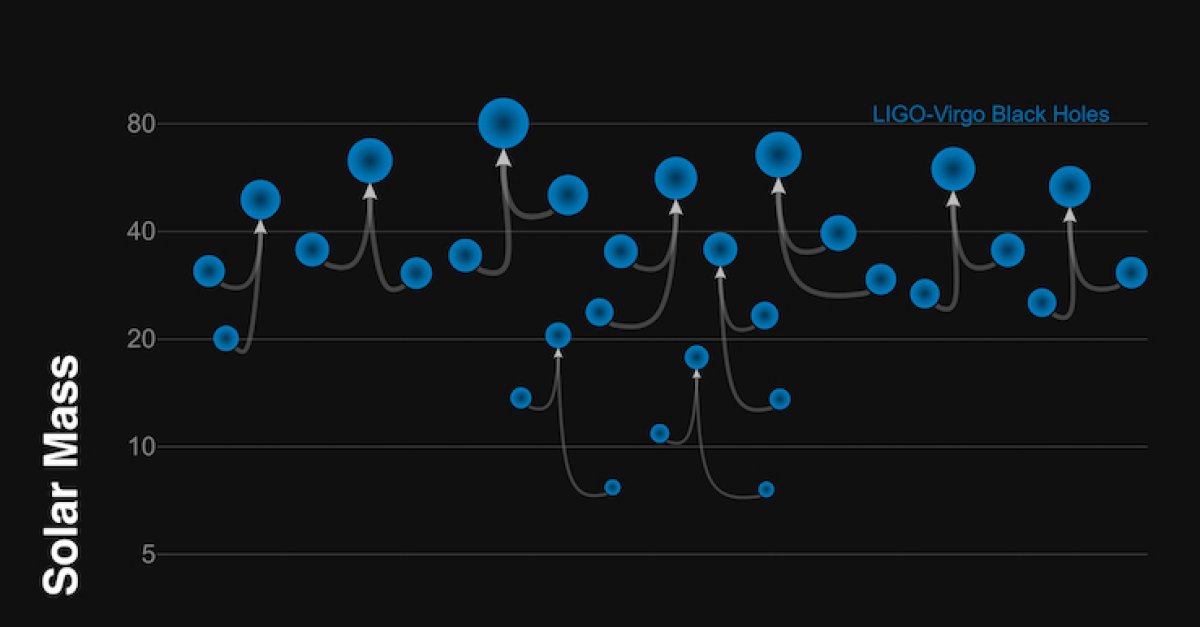 Currently, gravitational wave detectorsLIGO and Virgo have teamed up to discover 20 stellar mass black holes that merge to form black holes with masses of 20 to 80 solar masses. Although LIGO-Virgo has not detected any BHs (more than 100 solar masses), researchers are optimistic about their detection in the future.
Planck black hole (Micro black hole)
A Planck black hole is a hypothetical black hole with the smallest possible mass, which is equal to the Planck mass.
The density of matter of such a black hole isabout 1094 kg/m³ and is probably the maximum achievable mass density. Physics at such scales must be described by theories of quantum gravity that have not yet been developed. Such an object is identical to a hypothetical elementary particle with (presumably) the maximum possible mass—a maximon.
Planck black holes are characterized by extremelysmall cross section of interaction. The smallness of the cross section for the interaction of neutral maximons with matter leads to the fact that a significant (or even the main) part of matter in the Universe at the present time could consist of maximons, without leading to a contradiction with observations. In particular, maximons could play the role of invisible matter (dark matter), the existence of which is currently recognized in cosmology.
Supermassive black holes - the birth of giants
Small black holes inhabit the universe, but theircousins, supermassive black holes, dominate. These huge black holes are millions or even billions of times more massive than the Sun, but about the same size in diameter. Such black holes are believed to be found in the center of virtually every galaxy, including the Milky Way.
Scientists are not sure how such largeblack holes. Once these giants are formed, they collect a mass of dust and gas around them, a material abundant in the center of galaxies, allowing them to grow to even larger sizes.
Supermassive black holes could be the resultmergers of hundreds or thousands of tiny black holes. Large gas clouds may also be responsible for their collapse and rapid increase in mass. Or is it the collapse of a star cluster, a group of stars falling together. Supermassive black holes can arise from large accumulations of dark matter. This is a substance that we can observe through its gravitational effect on other objects; however, we don't know what dark matter is made of because it doesn't emit light and can't be directly observed.
A new class of black holes—“super-supermassive” or huge black holes
So, as we already know, our Universe containshuge black holes. The supermassive black hole at the center of our galaxy has a mass of 4 million Suns, but it is quite small, like galactic black holes. Many galactic black holes have a mass of one billion solar masses, and the mass of the most massive black hole known is estimated at about 70 billion suns. But how big can a black hole be?
To make the black hole really massiveshe must absorb a large amount of the substance at the beginning of her life. If it slowly consumes matter, then the surrounding galaxy will fall into place and the universe will expand, so that the black hole cannot capture much more matter. But when a black hole quickly engulfs a large amount of matter, the matter becomes very hot and tends to repel other matter, making it difficult for the black hole to grow.
Based on observations of the largest blacksholes and computer simulations of the formation of black holes, it is believed that the upper limit of the mass of galactic black holes is about 100 billion solar masses. But new research suggests that the mass limit could be much higher.
The work of scientists notes that, althoughgalactic black holes probably do have a solar mass limit of hundreds of billions; larger black holes may have formed independently in the early stages of the universe. These primordial black holes can be more than a million times the mass of the largest galactic black holes. The research team calls them incredibly large black holes or SLABs (stupendously large black holes).
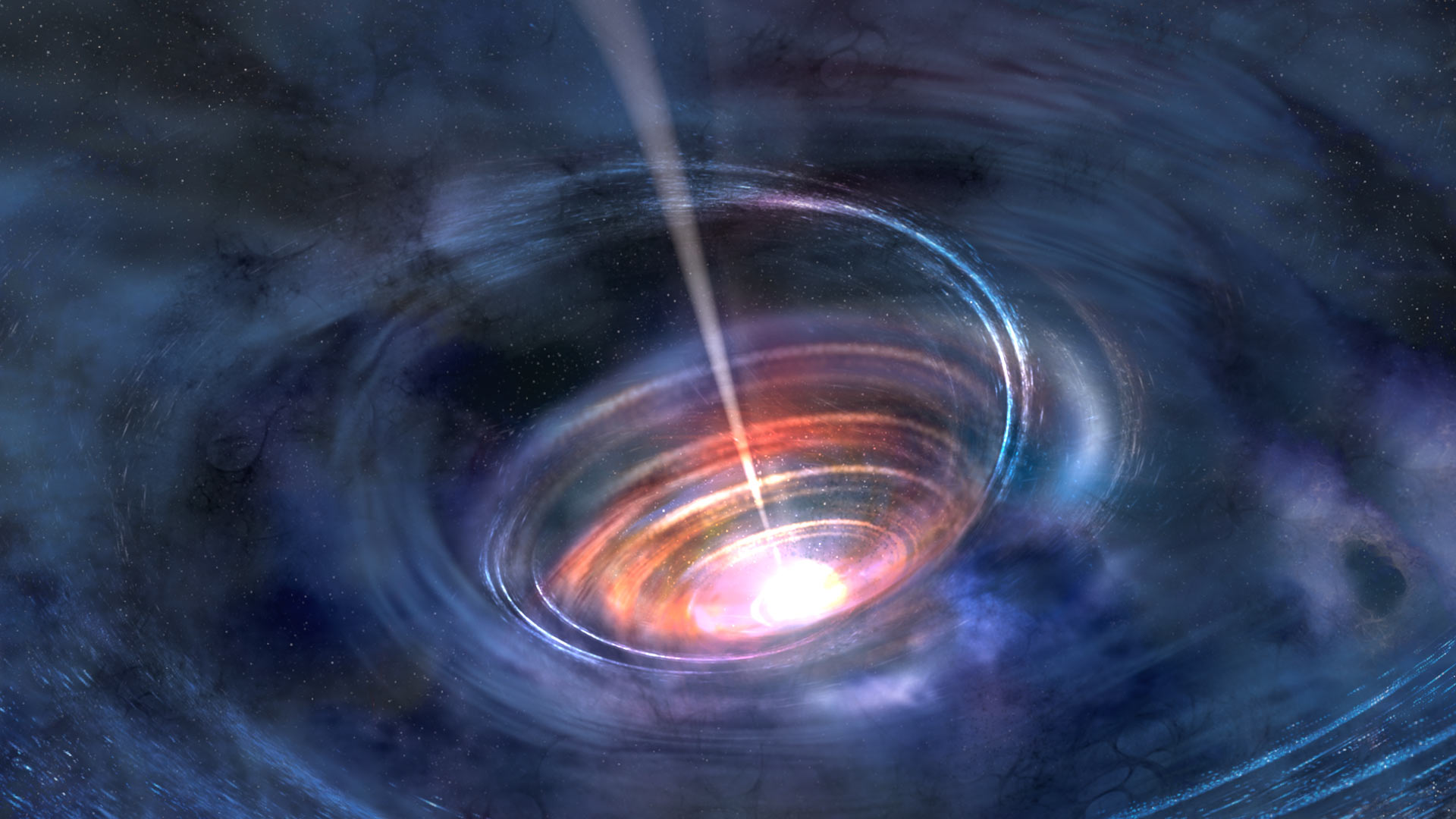
The idea of primordial black holes has been around for a long time.They have been proposed as a solution to everything from dark matter to why we haven't yet discovered a hypothetical ninth planet in our solar system. But theoretical models suggest that primordial black holes would be much smaller than even stellar mass black holes formed from tiny density fluctuations in the early universe. But this new study suggests that dark matter and other factors could cause colossal growth in some of them.
If the early universe was rich in darkmatter, especially a form of dark matter known as weakly interacting massive particles (WIMP), then the primordial black hole could consume dark matter to grow rapidly. Since dark matter does not interact strongly with light, trapped dark matter will not emit much light or heat to slow down its growth rate. As a result, these black holes could have been huge even before the universe cooled down and galaxies formed. The upper mass limit for SLAB will depend on how the WIMP dark matter interacts with itself, so if we detect any SLABs it could help us understand dark matter.
How can humanity use black holes?
The theory of relativity predicts thatrotating black holes can be used as energy sources. In 1969, Roger Penrose described a process for doing this. There is an ergosphere around the rotating black holes - the region that precedes the event horizon. All bodies in the ergosphere revolve with the black hole.
Penrose process (also called mechanismPenrose) theoretically views black holes as a means of extracting energy. Such extraction can occur if the black hole's rotational energy is not located inside the event horizon, but outside - in the region of Kerr space-time. In this ergosphere, any particle necessarily moves in a locomotive mode simultaneously with rotating space-time, i.e. all the objects in there are carried away by it. In this case, a piece of matter entering the ergosphere is split into two parts. For example, matter may consist of two parts that are separated by firing an explosive or a missile that pushes its halves apart. The momentum of two pieces of matter as they separate can be arranged so that one piece escapes from the black hole (it "escaps to infinity") and the other falls beyond the event horizon into the black hole. If placed carefully, the escaping part of the matter can have greater mass-energy than the original one, while the falling part of it receives negative mass-energy. Although momentum is retained, the effect is that more energy can be extracted from this process than was originally intended. Moreover, the difference is provided by the black hole itself. The process thus results in a slight decrease in the black hole's angular momentum, which corresponds to a transfer of energy to matter. The lost impulse, in turn, is converted into extracted energy.

The Penrose process indicates the possibilitygetting energy from a black hole, but it is not a good practical method. For its implementation, it is necessary that two newborn particles have a speed exceeding half the speed of light. The expected frequency of such events is so rare that it will not allow a significant amount of energy to be obtained.
Therefore, scientists are actively looking for other mechanisms.For example, Stephen Hawking showed that black holes can release energy through heat radiation. Another way to extract energy is the Blanford-Znaek process, based on electromagnetic interaction.
Luca Comisso of Columbia University and Felipe A. Asenjo of Adolfo Ibanez University describe another alternative to the Penrose process in their article.
Black holes are surrounded by hot plasma, particleswhich have a magnetic field. The basis of the new mechanism for obtaining energy from rotating black holes is the reconnection of magnetic field lines inside the ergosphere. In this case, the black hole should be in an external magnetic field, have a large spin (a ~ 1) and the surrounding plasma with strong magnetization. For example, black holes formed as a result of long and short gamma-ray bursts and supermassive black holes in active galactic nuclei possess the necessary properties.
Magnetic reconnection accelerates part of the plasma intothe direction of rotation of the hole. The other part accelerates in the opposite direction and falls beyond the event horizon. The release of energy, as in the Penrose mechanism, occurs if the absorbed plasma has negative energy, and the accelerated one “escapes” from the ergosphere. The difference is that the formation of particles with negative energy requires dissipation of the energy of the magnetic field. In the process described by Penrose, only the inertia of the particles plays a role.
As scientists say, the efficiency of the described process is 150percent. This means that the process allows you to get one and a half times more energy than you need to spend on its implementation. Achieving an efficiency of more than 100 percent is possible, because plasma particles released from the ergosphere carry away the energy of the black hole. The discovery of a new mechanism for extracting energy from black holes will allow astronomers to better estimate their rotational momentum and understand how they radiate energy. The discovery is still far from practical application: it is necessary to figure out how to fly to the black hole and place something in its ergosphere without falling beyond the event horizon.
Read more
Saturn's moon Titan is remarkably similar to Earth. What plans does humanity have for it?
Large numbers of gray whales start starving and dying in the Pacific
A third of those who have recovered from COVID-19 return to the hospital. Every eighth - dies
String theory is based on the hypothesis that allelementary particles and their fundamental interactions arise as a result of vibrations and interactions of ultramicroscopic quantum strings on scales of the order of the Planck length of 10−35 m