What are noctilucent clouds?
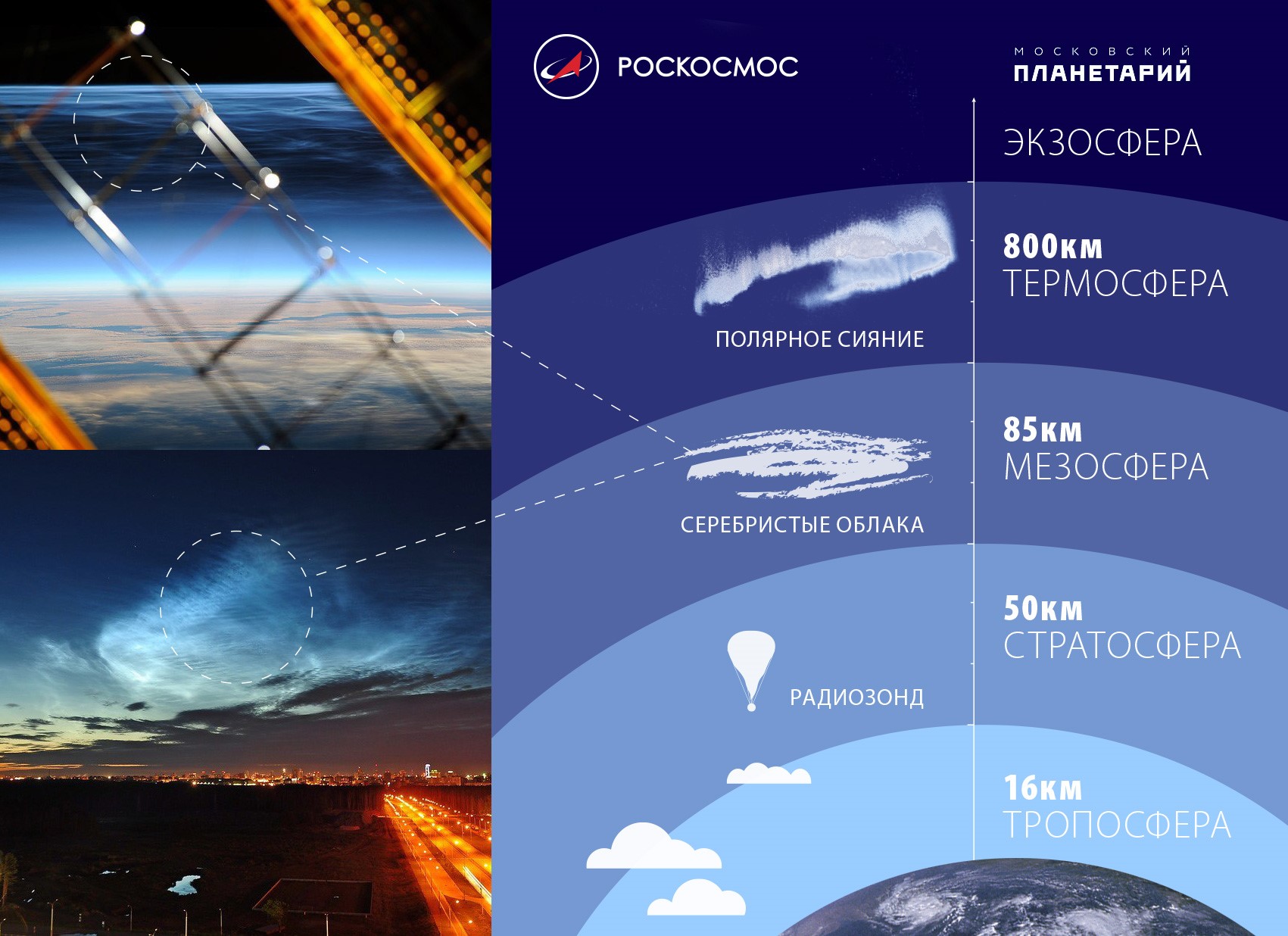
Noctilucent clouds form in the upper atmosphere, the mesosphere, on the
How are they formed?
Why are these clouds that need so lowtemperatures formed in summer? All because of the dynamics of the atmosphere. In fact, at this altitude in the mesosphere in summer near the poles the lowest temperatures of the year.
 Roskosmos
This is how it works:in summer, the air near the ground heats up and rises. As atmospheric pressure decreases with altitude, the rising air expands. When this happens, it also cools down. This, along with other processes in the upper atmosphere, raises the air even higher, forcing it to cool even more. As a result, the temperature in the mesosphere can drop to -134 ° C.
Because clouds are so sensitive to atmospheric temperatures, they give scientists more information about the wind circulation that causes those temperatures.
When were noctilucent clouds first discovered?
Noctilucent clouds are known to have been first detected in 1885, two years after the eruption of the volcano in Indonesia – Krakatoa – in 1883. It remains unclear whether their appearance had anything to do with the volcanic eruption or if their discovery was due to the fact that more people were witnessing spectacular sunsets caused by volcanic debris in the atmosphere.
Today noctilucent clouds are known to be caused bynot only volcanic activity, although dust and water vapor can enter the upper atmosphere as a result of eruptions and contribute to their formation. And yet, scientists at the time assumed that the clouds were another manifestation of volcanic ash. However, after the ash fell out of the atmosphere, the noctilucent clouds did not disappear. Finally, the theory that the clouds are composed of volcanic dust was refuted by Malsev in 1926.
In the years following their discovery, the clouds were scrutinized by Otto Jesse of Germany, who first photographed them in 1887.In addition, he was the first to coined the term "noctilucent clouds."
Systematic photographic observations of clouds were organized in 1887 by Wilhelm Förster and later by the staff of the Berlin Observatory.It was then that the height of the clouds was first determined by triangulation.The project was discontinued in 1896.
In the decades since Otto Jesse's death in 1901, research into the nature of noctilucent clouds has made little progress.Wegener's hypothesis that they were composed of water ice later proved to be correct.The research was limited to ground-based observations. Scientists knew very little about the mesosphere until the 1960s, when humans began to actively explore and explore space. Then it turned out that the appearance of clouds coincided with very low temperatures in the mesosphere.
Later, the Solar Mesosphere Explorer satellite mapped the distribution of clouds between 1981 and 1986 using an ultraviolet spectrometer. The first physical confirmation that water ice is indeed a major component of noctilucent clouds came from the HALOE instrument on the Upper Atmosphere Satellite in 2001.
In 2001, the Swedish satellite Odin conducted spectral analysis of clouds and compiled daily global maps, which revealed large patterns in their distribution.
Satellite AIM (Aeronomy of Ice in the Mesosphere),which was launched on April 25, 2007, was the first whose work consisted only of the study of noctilucent clouds. The first data appeared already a month later. The images taken by the satellite show cloud shapes similar to the shapes of tropospheric clouds, which hints at a similarity in their dynamics.
A study published in the journalGeophysical Research Lettersin June 2009, suggests that noctilucent clouds observed after the 1908 Tunguska event indicatethat the impact was caused by a comet.
What do noctilucent clouds look like?
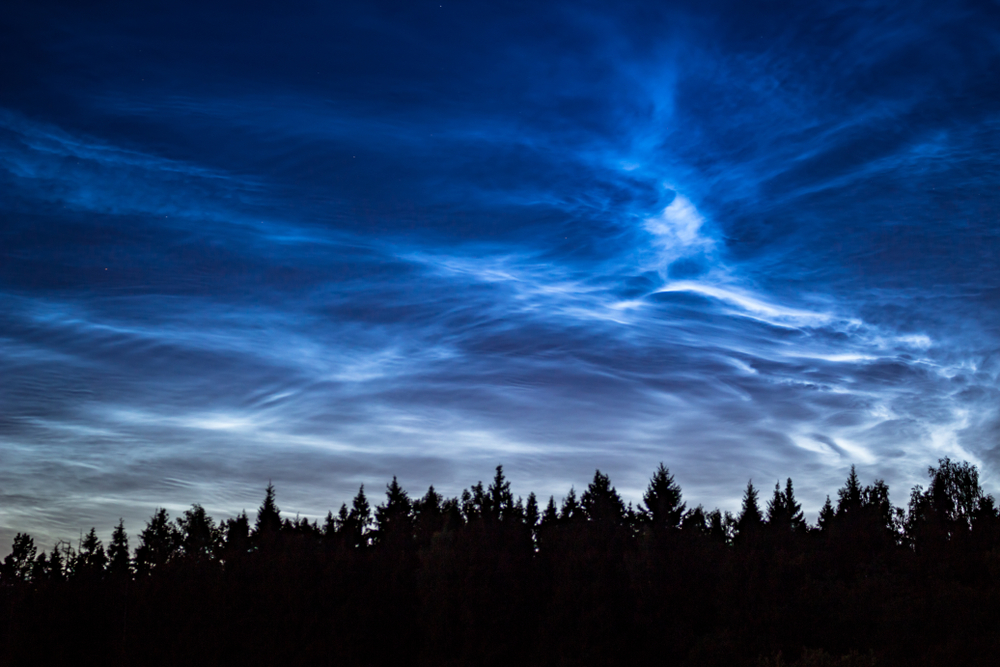
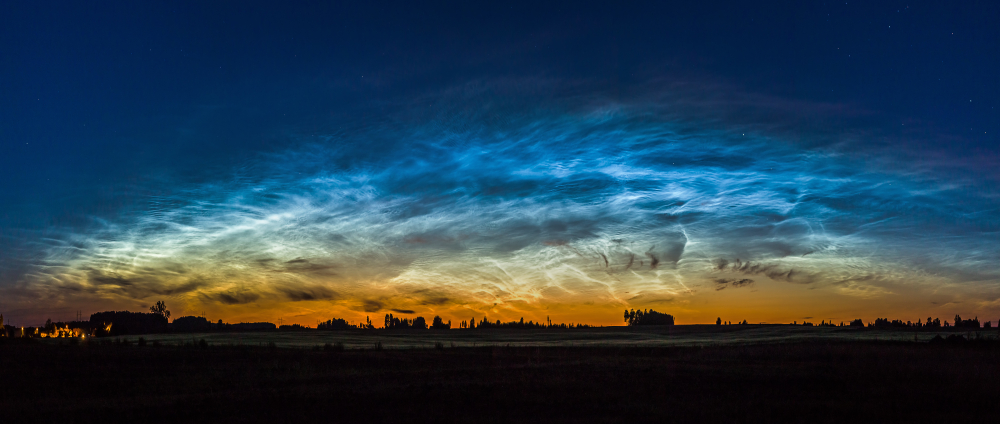
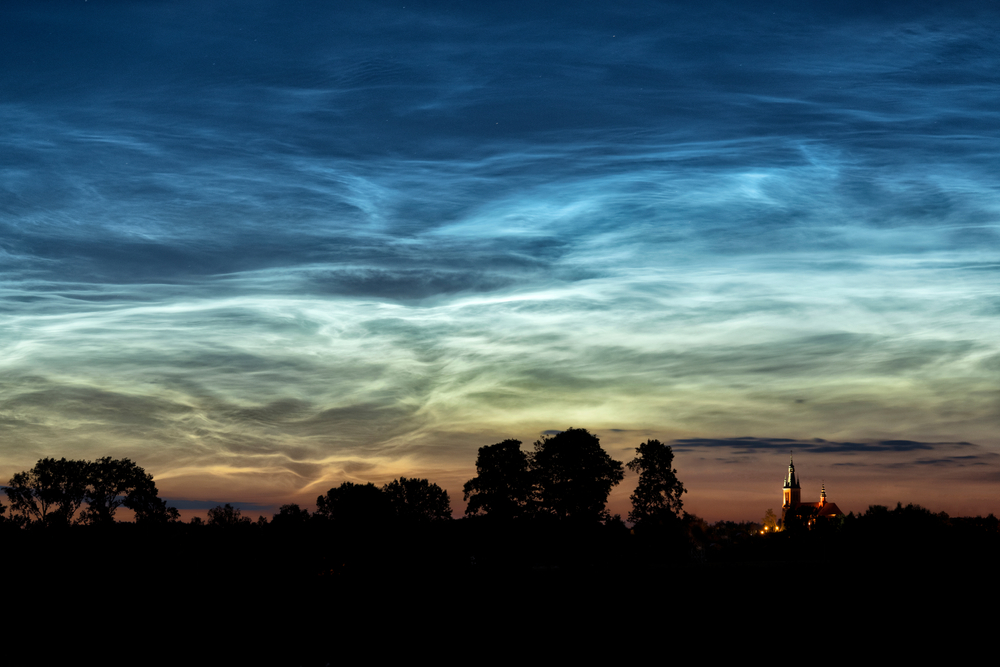
Noctilucent clouds are usually colorless orpale blue, although other colors are occasionally seen, including red and green. The characteristic blue color arises from absorption by ozone in the path of sunlight illuminating the silvery cloud. They may look like featureless stripes, but they often exhibit patterns - stripes, undulating waves and swirls.
How and where to observe noctilucent clouds?
Clouds can be observed only in summer in the Northhemispheres - they are usually seen in June-July at geographic latitudes from 45 to 70 degrees. Moreover, most often the phenomenon is observed from mid-June to mid-July at latitudes from 55 to 65 degrees.
Due to their high-rise position, silveryclouds glow only at night, scattering sunlight that hits them from below the horizon. During the day, even against the background of a clear blue sky, these clouds are not visible - for this they are too thin. Only deep twilight and night darkness make them visible to a ground observer.
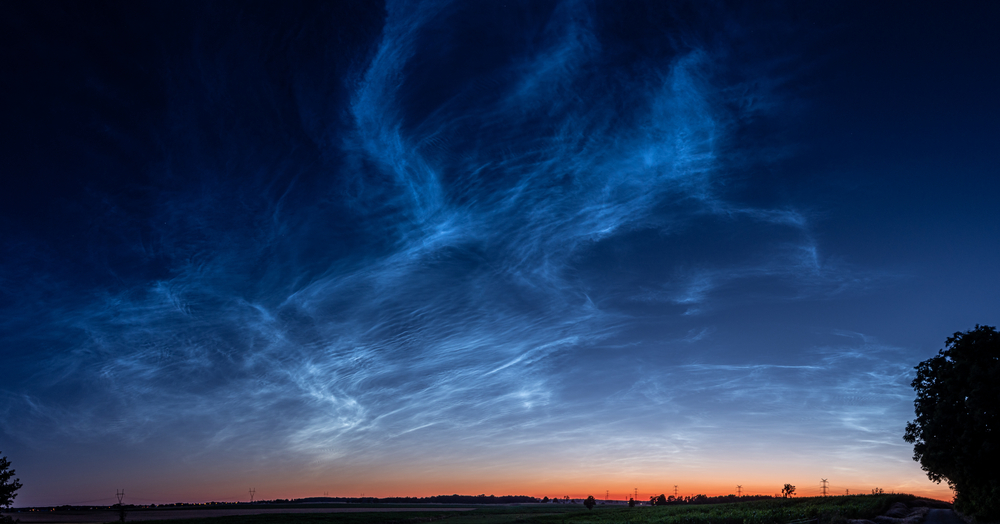
According to astronomers, notice noctilucent cloudsit is possible every year, but they do not always reach high brightness. At the same time, it is best to observe rare clouds around midnight above the northwestern horizon.
Read more
It's cool: how smart clothes work Under Armor Iso-Chill and what does titanium dioxide have to do with it
Physicists have recreated the first substance that appeared after the Big Bang
Tiny hydrogen engine replaces fossil fuel counterparts