The results of the study were presented at a scientific online webinar, which was attended by experts
What have the scientists done?
An international group of astronomers for the first timefound evidence of high-energy neutrino emissions from the galaxy NGC 1068 at a distance of 47 million light-years from Earth. It is also known as Messier 77 and is located in the constellation Cetus. Because of its brightness and activity, NGC 1068 is one of the most famous and well-studied objects. It was discovered back in 1780, and now it can be observed with large binoculars.
Despite the fact that scientists know a lot about NGC 1068, observing its hidden neutrino activity was not so easy. Why exactly, we will tell a little later.
How did they do it?
Scientists discover neutrinos thanks to observatoryicecube. It is a massive neutrino telescope covering a billion tons of processed ice from 1.5 to 2.5 km below the surface of Antarctica near the South Pole.
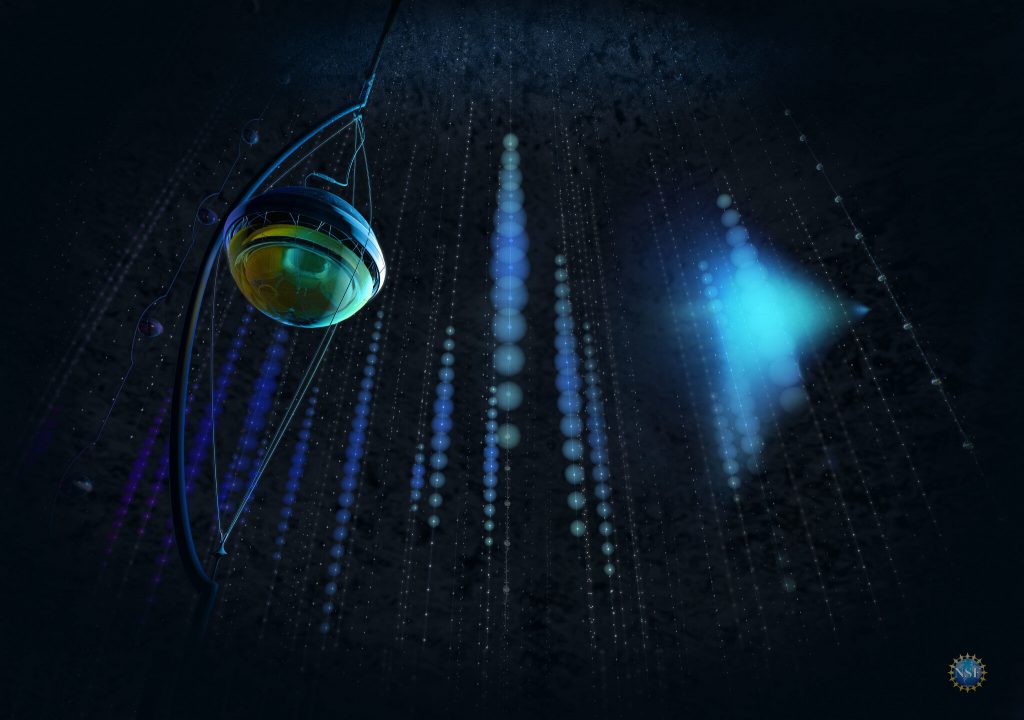 When a neutrino interacts with molecules in clear Antarctic ice, it produces secondary particles that leave a trail of blue light as they pass through the IceCube detector.
Image Credit & Copyright: Nicole R. Fuller, IceCube/NSF
This is a unique observatory that exploresthe farthest corners of the universe here on Earth, with the help of neutrinos. It is thanks to him that scientists reported the first observation of a high-energy neutrino source in 2018. We are talking about the object TXS 0506 + 056, a powerful blazar, which is located on the left shoulder of Orion, a constellation 4 billion light-years from Earth.
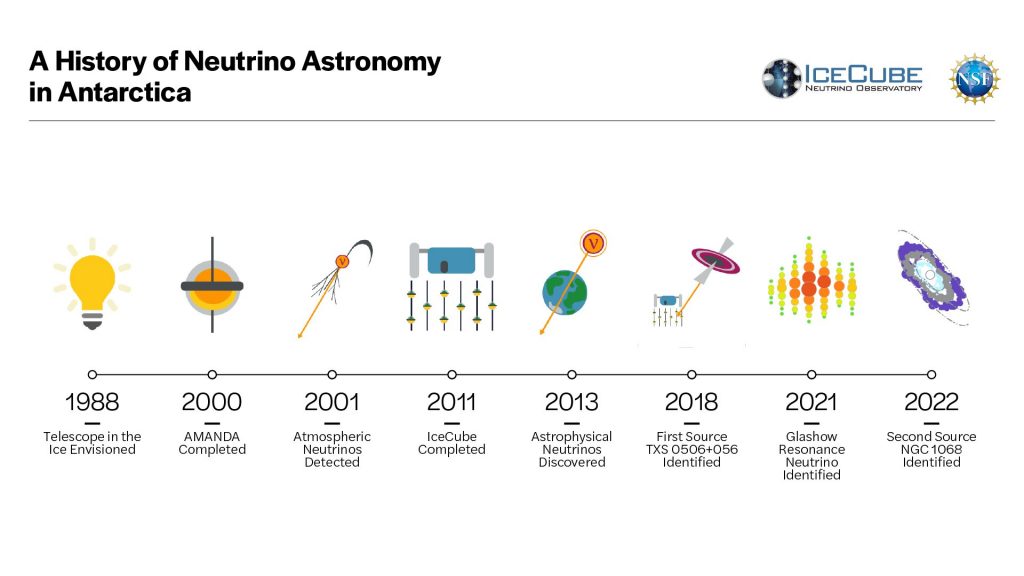 The discovery of a second source of high-energy neutrinos and cosmic rays is the result of more than 30 years of scientific research. Illustration: IceCube/NSF
When neutrinos interact with molecules in clear Antarctic ice, it produces secondary particles. They leave a trail of blue light as they pass through the IceCube detector.
In total, he accumulated about80 neutrinos of teraelectronvolt energy from NGC 1068. As the authors of the new study explain, they were able to “catch” the particles thanks to a careful update of the detector calibration. The work of equipment operation experts improved the reconstruction of the neutrino direction. In simple words, physicists were able to more accurately track the path of particles from NGC 1068.
What are neutrinos?
Neutrinos are the common name for neutralsfundamental particles with half-integer spin. Their peculiarity is that they participate only in weak and gravitational interactions and belong to the class of leptons. Now physicists know about three types of these particles: electron, muon and tau neutrinos, as well as their corresponding antiparticles. Another feature of neutrinos is that they have very little mass and no charge. They are born in thermonuclear reactions of stars and supernova explosions.
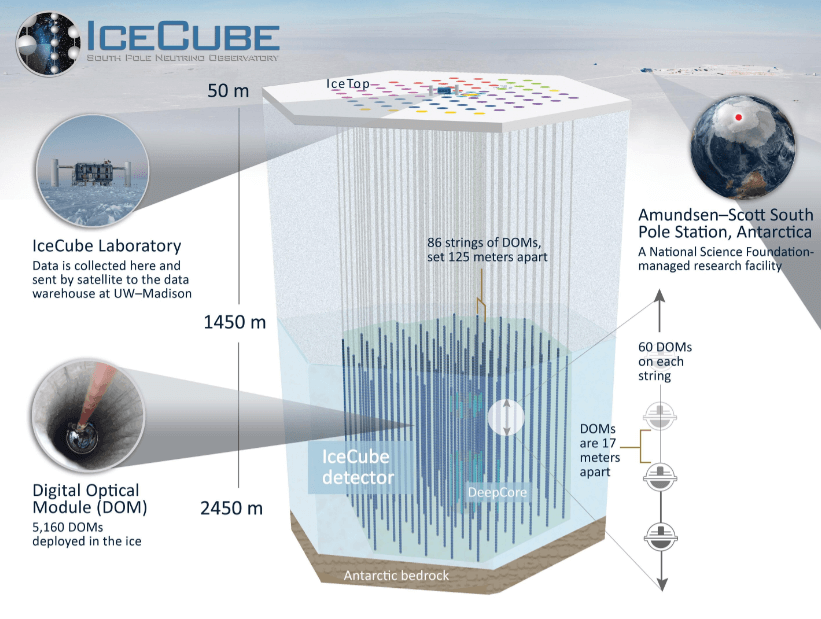 IceCube detector diagram. Illustration: IceCube/NSF
The study of these particles is one of the most important areas in physics. With their help, scientists find and study effects that are beyond the Standard Model.
Standard Model— theoreticala construct in particle physics that describes the electromagnetic, weak, and strong interactions of all elementary particles. The modern formulation was completed about 20 years ago after experimental confirmation of the existence of quarks.
With the help of solar neutrinos, astronomers study the processes that occur on the Sun in real time.
How does a neutrino "work"?
Unlike light, neutrinos can escape fromextremely dense environments in the Universe and reach the Earth. Matter and electromagnetic fields that permeate extragalactic space have practically no effect on them.
Although scientists came up with neutrino astronomy more60 years ago, the weak interaction of particles with matter and radiation made them incredibly difficult to detect. But this is still very important. Scientists call neutrinos a “key” that will help study the most extreme objects in space.
What is known about the galactic “neutrino supplier”?
As is the case with the Milky Way,NGC 1068 is a barred spiral galaxy with loosely wound arms and a relatively small central bulge. However, unlike our galaxy, NGC 1068 is an active object. This means that most of the radiation is produced not by stars, but by material that falls into the central black hole. It is millions of times more massive than the Sun and even Sagittarius A*, an inactive black hole at the center of our galaxy.
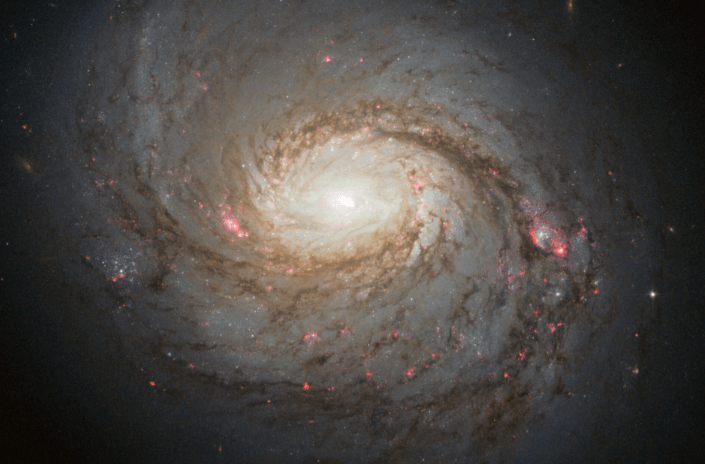 Hubble image of the spiral galaxy NGC 1068. Credit: NASA/ESA/A. van der Hoeven
NGC 1068 also belongs to type II Seyfert galaxies.
Seyfert galaxy - spiral oran irregular galaxy with an active nucleus, the emission spectrum of which contains many bright broad bands, indicating powerful gas emissions at speeds of up to several thousand kilometers per second. Type II objects have a characteristic bright core and also appear bright when observed in the infrared.
the main problem
NGC 1068 is visible from Earth at such an angle that itthe central region where the black hole is located is hidden from observation. The processes inside it remain a mystery. Also in Type II Seyfert galaxies, a torus of nuclear dust obscures most of the high-energy radiation. It is produced by a dense mass of gas and particles that slowly and spirally move inward toward the center of the galaxy.
All this, plus radiation, should blockgamma rays. Otherwise, they would “accompany” the neutrinos and help scientists. Now that physicists have calibrated IceCube's detectors and detected elusive particles from the core of NGC 1068, they are learning more about the environment around supermassive black holes, without taking into account gamma rays.
Why is counting neutrinos from galaxies so important?
According to the authors of the study, thanks toThe neutrino measurements of TXS 0506+056 and NGC 1068 IceCube are one step closer to answering the question about the origin of cosmic rays that scientists have been asking for more than a hundred years.
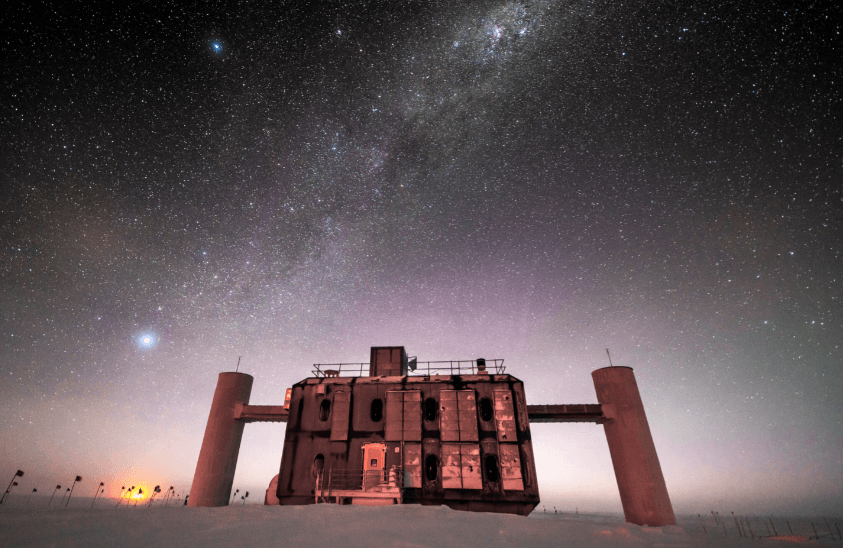 View of the IceCube Lab at dusk.
Credit & Copyright: Martin Wolf, IceCube/NSF
Now scientists know what they arestreams of separate and unrelated charged particles that “fly” from outer space at enormous speed. They are dominated by protons, but also contain electrons, helium nuclei and heavier chemical elements.
In addition, the study helped scientists understand that there may be many more such objects in the universe. They have yet to be identified.
What's next?
In the future, NGC 1068 will become a benchmark forneutrino telescopes, according to the authors of the study. Yes, this is already a very well studied object for astronomers. But neutrinos will allow scientists to see this galaxy in a completely different way.
Read more:
Named the consequences of the last solar storm that hit the Earth
A massive impact from a space object triggered the Earth's magnetic field
A huge tunnel under the Egyptian temple “hidden” mysterious artifacts
Sources:
Evidence of neutrino emission from nearby active galaxy NGC 1068, Science (2022)
Neutrinos Reveal Hidden Galactic Activity, Science (2022)
Cover: barred spiral galaxy NGC 1068
Contributors: NASA, ESA, Alex Filippenko (UC Berkeley), William Sparks (STScI), Louis C. Ho (KIAA-PKU), Matthew A. Malkan (UCLA), Alessandro Capetti (STScI), Alyssa Pagan (STScI)