What signals are we talking about?
About those that can be caught through existing telescopes and radars. For example,
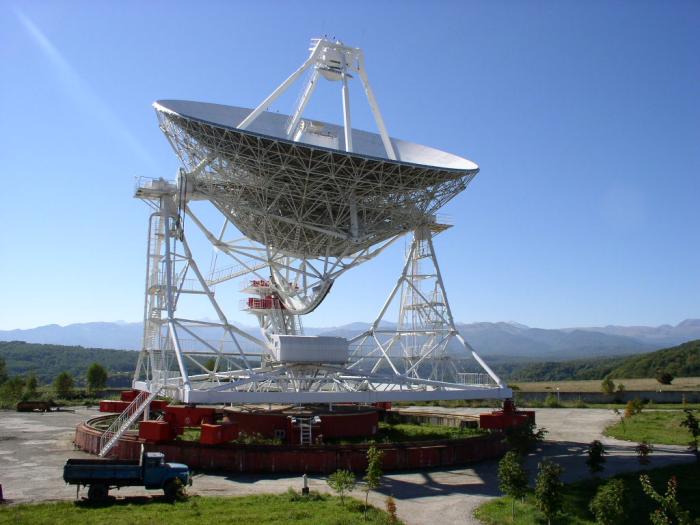 Radio telescopeRTF-32 Zelenchukskaya Observatory North Caucasus
Radio waves can travel in outer space without any problems; they are emitted by many celestial bodies. For example, our Milky Way galaxy makes hissing noises.
In July 2006, researchers launchedweather balloon from NASA's Columbia Aerostat Center in Palestine, Texas. Scientists looked for traces of heating from first-generation stars in the upper atmosphere, at an altitude of 36.5 km, where it turns into airless space.
Instead, they heard an unusual radio hum. It came from deep space, and researchers still do not know for sure what caused it and where its source is.
Who can emit these signals?
- Neutron star
When a star explodes and dies, it canturn into a fast spinning neutron star. Astronomers believe that those who are in the area of a strong magnetic field can emit such strange signals.
- Merging of two stars
Another possible explanation is the collision of two neutron stars.
According to Montreal astronomer SriharshTendukara, this version works only for non-repeating cosmic signals, since stars are destroyed during the collision. Most of the radio bursts recorded by telescopes over the last decade are just single ones.
However, the two detected signals will be repeated over and over again, and they will have to find another explanation.
- Blitzar
Blitzar is a hypothetical type of space object, proposed as one of the explanations for the origin of fast radio pulses.
A rapidly spinning neutron star, which cannot bear its own weight, contracts sharply and turns into a black hole.
- Black hole
There is a version that radio bursts are emitted by a neutron star falling into a black hole. Or the black hole itself, sharply decreasing in size. Or dark matter colliding with a black hole.
- UFO
While many believe the radio signals are purely natural, some believe that they may be evidence of extraterrestrial life.
What unusual bursts have scientists recorded?
- Signal "Wow!"
This is a strong narrowband radio signal,recorded by Dr. Jerry Eyman on August 15, 1977, while working on the Big Ear radio telescope at Ohio State University. Listening to radio signals was carried out as part of the SETI project. The signal characteristics (transmission bandwidth, signal-to-noise ratio) corresponded (in some interpretations) to those theoretically expected from a signal of extraterrestrial origin.
Amazed at how accurate the specs areof the received signal coincided with the expected characteristics of the interstellar signal, Eiman circled the corresponding group of symbols on the printout and signed the side "Wow!" ("Wow!"). This signature gave the name to the signal.
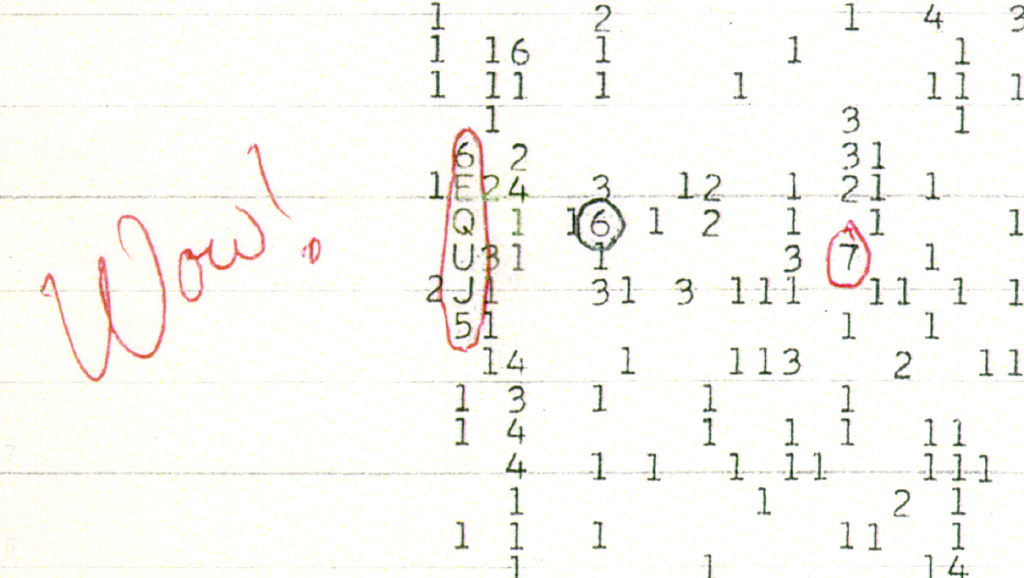
The code circled 6EQUJ5 describes the changethe intensity of the received signal in time. Each line on the printout corresponded to a 12-second interval (10 seconds of actually listening to the air and 2 seconds of subsequent computer processing).
Determining the exact location of the sourcesignal in the sky was hampered by the fact that the Big Ear radio telescope had two feeds oriented in several different directions. The signal was received by only one of them, but the limitations of the data processing method do not allow us to determine which particular feed unit recorded the signal. Thus, there are two possible values for the right ascension signal source.
Signal was expected to be recordedtwice - once with each of the irradiators - but this did not happen. The next month, Eiman tried to register the signal again with the help of the Big Ear, but to no avail.
- SHGb02 + 14a radio signal
SHGb02 + 14a radio signal - discovered in March2003, participants in the SETI @ home project and at that time was the best candidate for artificial origin, for the entire time of the SETI search for extraterrestrial life program.
The source was observed three times with a total durationabout 1 minute at a frequency of 1420 MHz at which hydrogen, the most abundant element in the universe, absorbs and emits energy. Scientists from SETI @ home are studying this part of the radio spectrum, as some astronomers claim that alien signals can be detected at this frequency.
There are a number of features of this signal,which led to great skepticism regarding its extraterrestrial artificial origin. The source was located between the constellations Pisces and Aries, where there are no stars within 1,000 light years. The signal frequency changed very quickly - from 8 to 37 Hz/s.
If the cause of the frequency change is the effectDoppler, this would mean that the source is on a planet rotating almost 40 times faster than the Earth (for comparison, a transmitter installed on Earth would change frequency at a rate of about 1.5 Hz/s).
In addition, upon initial signal detectioneach time its frequency corresponded to 1 420 MHz, while a signal with a changing frequency must be detected at different frequencies within its oscillation.
 Arecibo Observatory
- BLC-1 radio signal
BLC-1 is a candidate for radio signals of the SETI project,potentially emanating from the exoplanet Proxima Centauri b. The signal has a frequency of 982.002 MHz. The shift in its frequency corresponds to the orbital motion of Proxima b.
The radio signal has been registered for 30hours of observations by Breakthrough Listen at Parks Observatory in Australia in April and May 2019. Signal detection announced in December 2020. As of December 2020, follow-up observations were again unable to detect the signal, which is necessary to confirm that the signal was a technosignature.
- “Intriguing signal” from Proxima Centauri
Astronomers searching for radio signals from alien civilizations have discovered an "intriguing signal" from Proxima Centauri, the closest star system to the Sun.
The signal is a narrow beam of 980 radio wavesMHz discovered in April and May 2019 with the Parkes Telescope in Australia. The signal was recorded only once. This frequency is important because, as Scientific American points out, it is in this band of radio waves that signals from artificial ships and satellites are usually absent.
The Guardian, citing a source withaccess to data about this signal, reports that it is the first serious candidate for alien communication since the Wow signal. But the Guardian warns that this signal is “likely to be of terrestrial origin.”
Can the signals really be associated with extraterrestrial life?
It is not known exactly, but their search continues.For example, the SETI project was organized in order to search for extraterrestrial civilization. Some astronomers have long believed that there are so many planets in the Universe that even if a small part of them are suitable for life, then thousands or even millions of planets must be habitable.
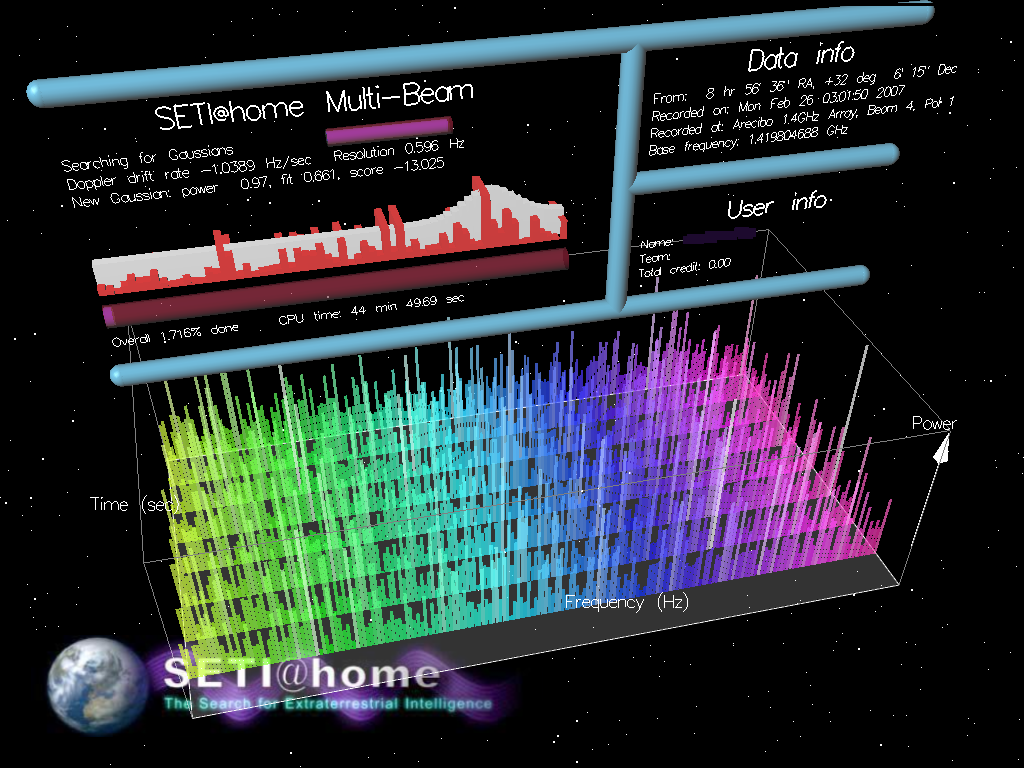 Splash screen capture for SETI @ Home, a distributed computing project in which volunteers donate computer idle time to analyze radio signals to find signs of extraterrestrial intelligence
However, over time, realistic estimates of the number of civilizationsmuchfell and the number of skeptics increased (see: Drake equation, Fermi paradox). At the same time, recent advances in astronomy and physics have strengthened the idea of the existence of many planetary systems suitable for life as such.
There are two approaches to the search for extraterrestrial intelligence:
- Look for signals from extraterrestrial civilizations. Relying on the fact that fellows in reason will also seek contact. There are three main problems with this approach: what to look for, how to look and where to look.
- Send a so-called "ready signal".Relying on the fact that someone will look for this signal. The main problems of this approach are actually similar to the problem of the first approach, with the exception of minor technical problems.
In the new work, scientists suggested looking for"Light" traces of extraterrestrial civilizations. So, for example, they propose to register the illumination of the night side of exoplanets, (for example, by the light of cities). Assuming the planet's orbit is elliptical, astronomers have shown that it is possible to measure the variation in the brightness of an object and detect whether its dark side is illuminated. At the same time, however, scientists assume that the luminosity of the dark side is comparable to the luminosity of the day (for the Earth, these values differ by five orders of magnitude).
In addition, scientists intend to look for bright objectsin the Kuiper belts around other stars with subsequent spectral analysis of their emission. Astronomers believe that such an analysis will determine the nature of the lighting - whether it is natural or artificial. Scientists emphasize that all the proposed options are not feasible using existing technology. At the same time, in their opinion, telescopes of a new generation, such as the American "James Webb", may well cope with the tasks described in the work.
Read more
Check out the most beautiful pictures of Hubble. What has the telescope seen in 30 years?
Ancient people saved themselves from the cold by hibernation
Astronomers have discovered an "intriguing signal" from the closest star system to the Sun