In 1980, University of Chicago statistics professor Stephen Mac Stigler formulated the law
Five years later, Soviet cosmonaut VladimirDzhanibekov, observing the behavior of the nut in weightlessness, noticed an unusual effect. As if in confirmation of Stigler's law, it will be called the Dzhanibekov effect, although in fact it is a consequence of the key postulates of classical mechanics, formulated long before that.
What did the astronaut see?
The cargo delivered into orbit, as a rule,closes with special wing nuts or butterflies. This is such a design with small ears that does not require a special tool to unwind it. In weightlessness, it is enough to hit one “ear” of a butterfly and it will spin itself. At the same time, in orbit, having jumped off the rod, the nut will continue to move, rotating in the air.
During the space rescue operationstation "Salyut-7" Vladimir Dzhanibekov noticed that if you do not touch the nut, then, after flying a short distance, it will independently turn 180 ° in the air and continue to fly. After some time, this will happen again.
The astronaut conducted many experiments, buteach time the results were the same. The nut rotating in the air constantly made 180° turns at equal distances. Having experimented with other objects, for example, with an ordinary nut to which a plasticine ball was attached, Dzhanibekov became convinced that it was not only the butterfly nut that exhibited unusual behavior.
Demonstration of the Dzhanibekov effect in weightlessness. Video: NASA
How to explain it?
First post explaining strange behaviorobject rotating in weightlessness appeared in 1991. But the effect itself was known long before that. Back in 1834, Louis Poinsot in his work "The New Theory of Rotation of Bodies" showed that the rotation of a body around the intermediate (average) main axis of inertia is unstable. While rotation around the other two axes is stable. The general principles describing the rotation of a rigid body were formulated even earlier by the mathematician Leonhard Euler in the Euler rotation theorem.
Recall that the main axes of inertia of the body are calledsuch coordinate axes in the Cartesian system, relative to which the centrifugal moment of inertia is equal to zero. The main axes of inertia passing through the center of gravity of the body are called the main central axes of inertia of the body. Three main axes can be drawn through any point of the body, and all of them will be mutually perpendicular.
Unusual somersaults in the air are explained by smalldeviations that occur during rotation. If you spin the body strictly around the average main central axis (the one whose moment of inertia occupies an intermediate position), nothing will happen. But in real conditions, rotation occurs not only around one axis. Small vibrations lead to the body beginning to rotate around all three axes.
Rotation of a rigid body in a coordinate system,associated with the body itself is described by the Euler equations. If we apply them to a rigid body with three different moments of inertia, we can see that when rotating around the average axis of inertia, the angular velocity around the smaller of the axes will increase, which will lead to a flip. In the other two cases, side effects decrease during rotation.
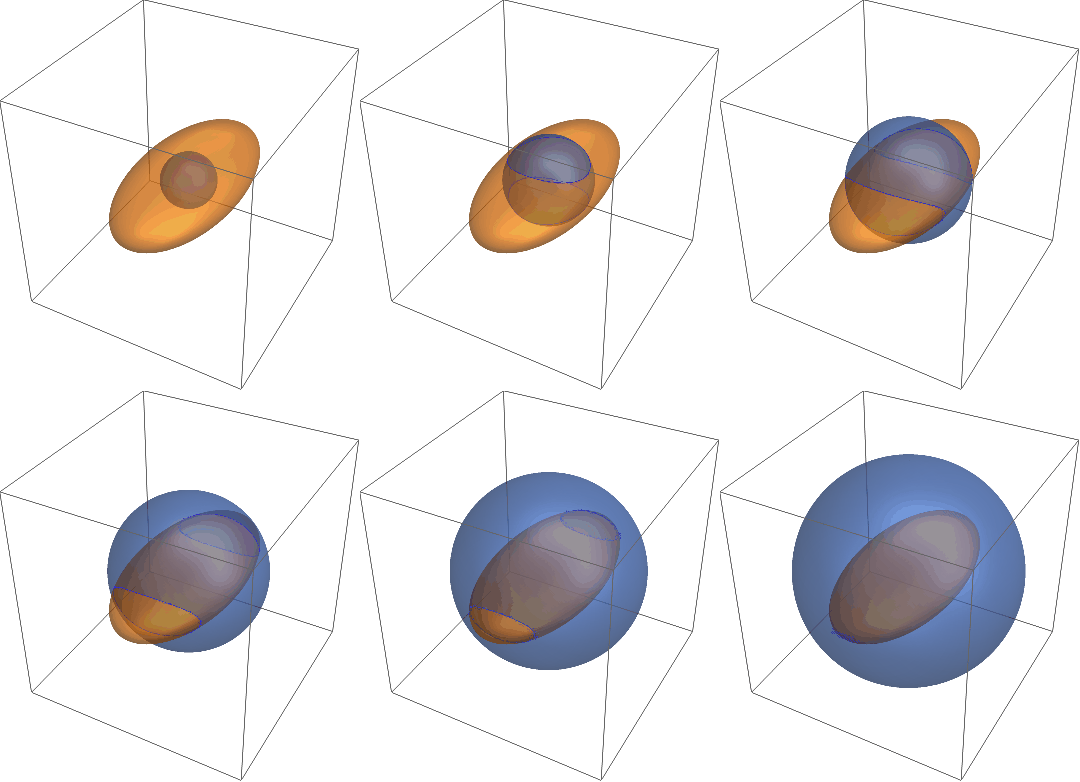 Visualization of mid-axis instability.The magnitude of the angular momentum and kinetic energy of the rotating object are conserved. As a result, the angular velocity vector remains at the intersection of the two ellipsoids. Image: Student298, CC BY-SA 4.0, via Wikimedia Commons
How can you observe?
The Janebekov effect can be observed not only inspace in weightlessness, but also on Earth. All you need is a tennis racket. You need to take the racket by the handle so that its plane is horizontal. If you toss it in such a way that it makes a complete revolution around a horizontal axis perpendicular to the handle, and then catch the racket, it turns out that it also made half a revolution around the vertical axis.
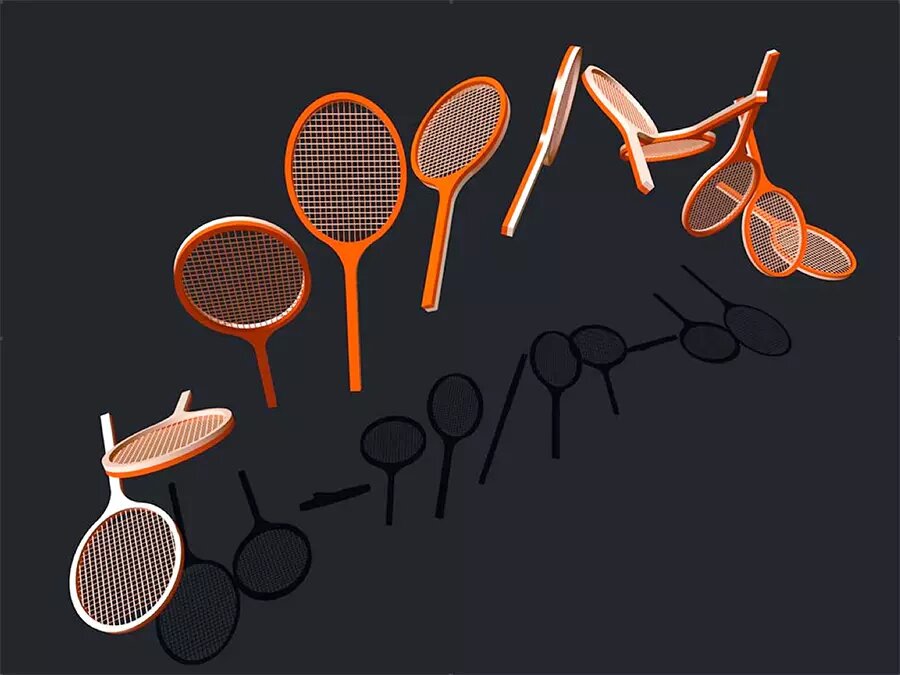 Rotation of a tennis racket in flight. Image: Steffen Glaser, TUM
On the contrary, if, while tossing the racket, to give it rotation around one of the other two axes (passing around the axis of the handle or the vertical axis), then the rotation will be carried out only around them.
The same experiment can be repeated with anya rigid body that has three different principal moments of rotation. For example, a book or a smartphone will do. Although experiments with the latter are fraught with a broken screen, and we do not recommend them, the Dzhanibekov effect will work. In both cases, the middle axis will be perpendicular to the long side of the book or phone.
 Rotating a tennis racket. Image: Cmglee, CC BY-SA 4.0, via Wikimedia Commons
Just pretty math?
The Dzhanibekov effect is not just a fun fact,which is interesting to watch. Random rotations can change the trajectory of a spacecraft or satellite. In this case, you should not worry about the rotation of the Earth or satellites. In these cases, the rotation is influenced by other forces, such as tidal forces, which are able to dissipate the energy of rotation around other axes, as a result of which the body rotates stably around the axis with the largest torque.
In addition, the Dzhanibekov effect has found application inquantum physics. The quanta also have an angular momentum, known as spin. It can be influenced by applying an electromagnetic field. In a paper published in the journal Scientific Reports, the scientists found that changes in spin behavior can be described using the same mathematical formulas that explain the spinning racket theorem.
This theory can be applied to purposefullychange the spin orientation, thereby minimizing errors caused by small perturbations. This helps to optimize the electromagnetic control of quantum states.
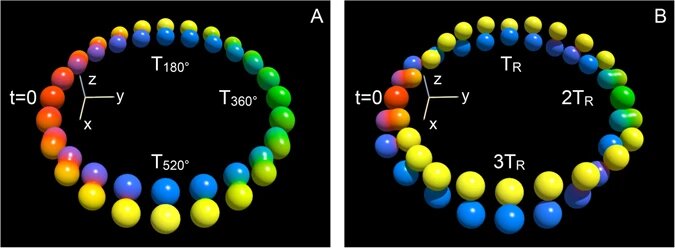 An illustration of the spinning racket theorem for quants. Image: Van Damme et al., Scientific Reports
Read more:
Scientists have come close to unraveling the secrets of the pyramids: how ancient people were able to build them
The mechanism of maintaining liver health in old age is revealed
Physicists explain Hawking's 'cosmic mismatch': how it will change science