Researchers have developed a wireless device that activates or inhibits neurons in the brain.
Researchers have demonstrated the work of a newdevice when implanted into the brain of laboratory mice. It is one of the most popular animal models used to study the biological principles of the human brain. Due to the absence of wires and batteries, the device allows you to observe brain activity in real conditions.
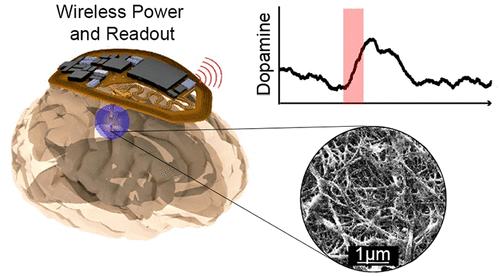 Wireless implant and dopamine. Tucker Stuart et al., ACS Nano
In their device, engineers useda miniature dopamine sensor based on carbon fiber composite electrodes. To create a tiny, flexible implant, they installed the sensor inside a wireless electronic circuit powered by external transmitting antennas. The finished device is 50 times lighter and 10 times smaller than the most advanced alternative, the developers say.
The researchers conducted a series of experiments onmice, during which the implant stimulated various areas of the brain and registered dopamine activity in response to the effects of opioids and naloxone. The technology will be useful in studying how neurochemicals affect behavior, addiction and the development of neurological diseases, the authors of the work say.
In future studies, the scientists plan to adapt their sensors to track other types of neurotransmitters.
Read more:
The strongest class X flare occurred on the Sun
Look at the consequences of the collision in 1181 of two stars
Blazar, which was found 20 years ago, turned out to be an extreme object