Scientists from the Royal Institute of Technology in Sweden have learned to collect electricity, which
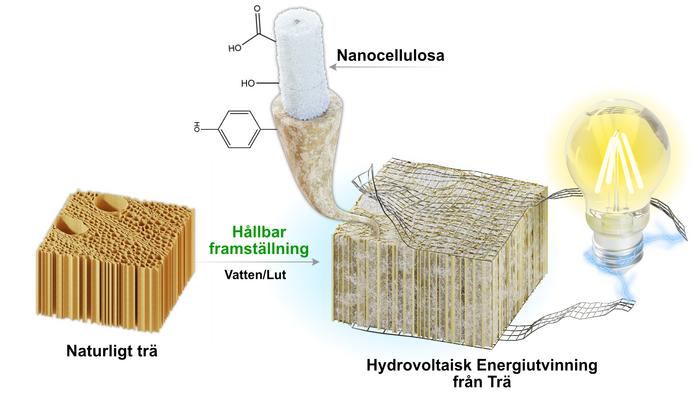 Illustration of modifying wood to produce electricity. Image: Yuanyuan Li
As a result of a series of structure modificationsthe cell walls of wood, the researchers managed to increase the amount of electricity generated up to 140 mV. This is 10 times more than ordinary wood. This amount is not enough to light the house, but enough to connect a simple device, such as an LED lamp or a calculator.
The method described by the researchers in an article injournal Advanced Functional Materials, is based on the use of nanoengineering. Scientists have changed the nanoscale composition of wood to improve its properties. They managed to control the surface area, density, surface charge. In addition, depending on the modifications used, how easily water can pass through the material changed.
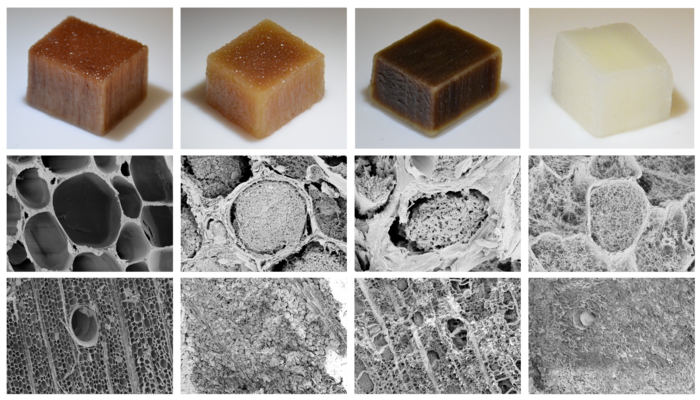 Various modifications of the wood structure. Image: Yuanyuan Li
The researchers believe that further customizationthe pH difference between wood and water will help to achieve a potential of up to 1 V and an output power of 1.35 µW/cm². At the same time, wood can only withstand 10 recharge cycles and generates high voltage for about 2-3 hours before it starts to weaken.
The advantage of this technology is that the wood can be easily used for other purposes once it is depleted as an energy source.
Yuanyuan Li, study co-author
Read more:
Scientists from the permafrost zone: how they develop smart clothes and a cancer vaccine
"The Walking Dead" existed millions of years ago: scientists told how they appeared
The egg was dropped from space: look what happened to it