China has completed construction of the Daocheng radio telescope. The object is a circle located on
After setting up, calibrating and testing the telescopewill be launched in June 2023. The main purpose of the new instrument is to monitor solar flares and coronal mass ejections. The telescope's 313 antennas will achieve high sensitivity for more accurate space weather prediction, the researchers note.
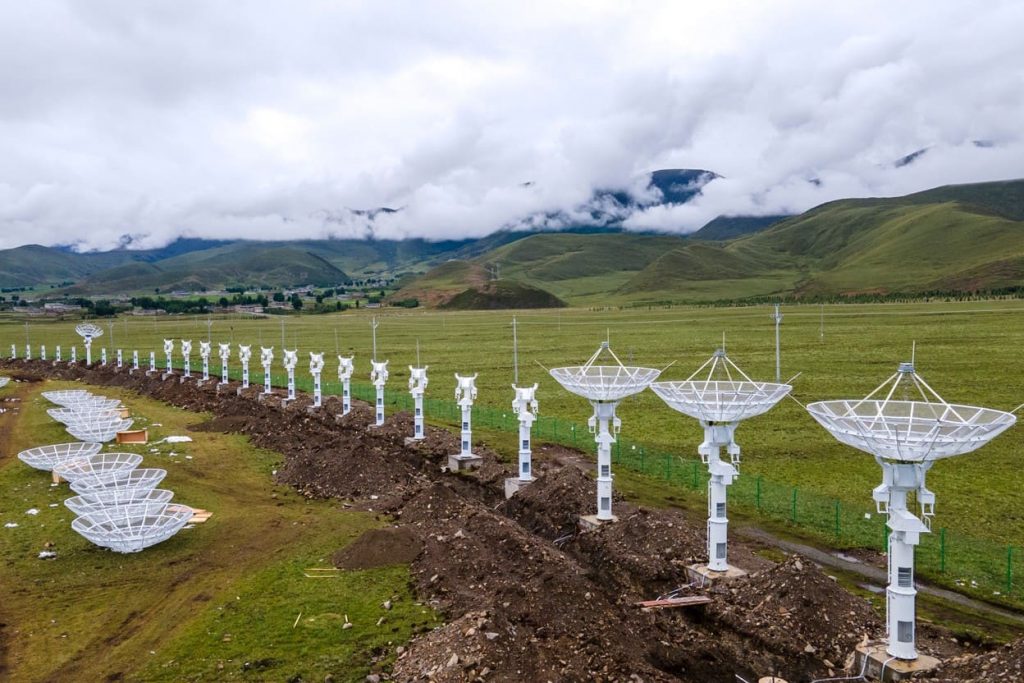 Construction of the Daocheng radio telescope. Image: Liu Zhongjun/China News Service
A large array can potentially captureweaker signals from high-energy particles, which can be missed by arrays observing in the same frequency range - from 150 to 450 MHz, the scientists note.
Telescope observation data will be available forinternational researchers. And the National Space Science Center of China, which oversees its work, plans to open the telescope at night for other types of observations, such as pulsar studies.
In the next few years, the Sun will enter the phasehigh activity. The radio frequency data that the new telescope will collect will complement the observations of existing devices operating in other frequency ranges, the scientists say. Together they will help to better predict space weather and explore the processes occurring inside the Sun.
Read more:
See what a woman Thora looks like. She lived 800 years ago
Rules for communicating with digital natives: omnichannel, usability and a single window
Look at the result of a "head-on collision" of two galaxies: this is a very rare occurrence.
On the cover: a coronal mass ejection on the Sun. Image: NASA/GSFC/SDO