An airplane engine is a maze of twisting, rotating tubes that transport liquids and gases through
Their invention is mechanical rainworms with "muscles" made from dielectric elastomer actuators and "legs" made from carbon fiber composites. The development is described in detail in an article published in the peer-reviewed journal Science Robotics.
Existing methods for checking aviationengines are time-consuming and require highly qualified engineers. We hope that in robots will do this type of work to save time and effort.
Huichang Zhao, one of the study's co-authors, in an interview with IE
This is not the first robot designed for inspectioncentimeter- and millimeter-scale pipes. Other designs use wheels or other means to move around enclosed spaces. But these solutions are not always practical, say the authors of the new work. One reason is that conditions in different pipelines can vary greatly, even within the same motor. These designs may also struggle to perform two equally important tasks for this type of robot: locomotion and inspection.
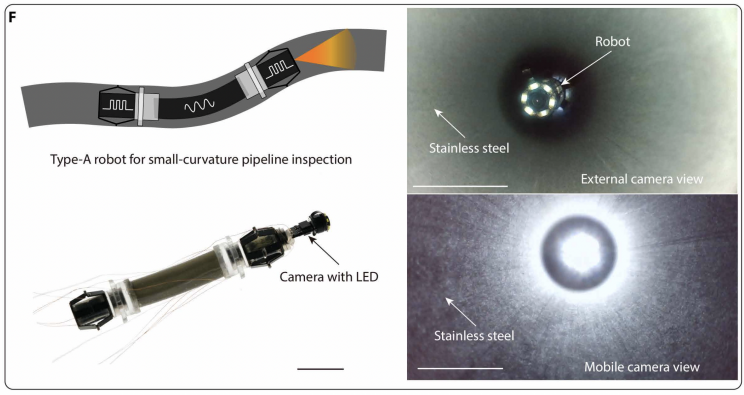 Images of a robot with a front-mounted camera and a robot surveying the environment in a stainless steel tube.
Source
To mitigate these limitations, engineersinspired by pneumatically powered robots that use compressed air to move along their entire length, crawling like worms. They are easier to seal and shrink to small sizes because they do not have complex protrusions such as wheels or legs. However, these robots tend to be slow.
New design allows it to movecompletely different. Instead of compressed air, the earthworm-like device uses electrical charges to move in waves through the pipe.
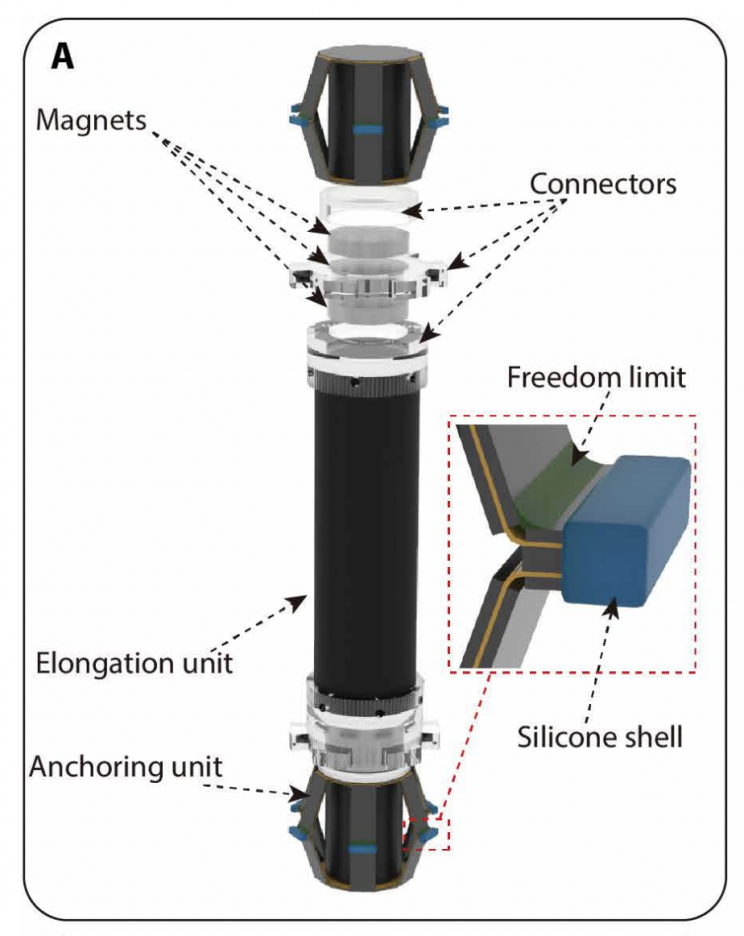 Schematic representation of the robot.
Source
The key technology of the robot is artificial muscles,also known as soft actuators or dielectric elastomer actuators. They are powerful and small enough to make the robot move quickly in a pipe. The charges cause the actuators to contract rapidly, allowing the 47mm long machine to move at a rate of one body length per second. The robot is made up of segments that can be joined together using magnets, allowing the operator to customize the exact design depending on the specification of the line that needs to be inspected .
“We can put such a robot in an aircraft engine conveyor and make it move along its entire length, sending images along the way,” the scientists conclude.
Read more
Gravity and dark matter do not exist: the main thing about the new work of physicists
Something strange is happening in the Universe: how to explain inconsistencies in the Hubble constant
Why do they really want to cancel the Bologna system of education in Russia