Researchers from the European Union-funded Copernicus remote sensing program
At the same time, 2022 entered the top 5 for the highestaverage global temperature and became the second hottest year for Europe, surpassed only by 2020. Scientists called the past year the year of extreme climatic events.
Change in global temperature
According to the Climate Change Watch“Copernicus”, the hottest year for the whole world remains 2016, when the average annual temperature exceeded the pre-industrial level (observation period from 1850 to 1900) by almost 1.4 °C. 2022 was also inferior in temperature to 2020, 2019 and 2017.
Researchers note that data from differentobservations vary slightly: different observation services rank 4–8 places in the ranking differently. This is due to the fact that in 2015, 2017, 2018, 2021 and 2022 the average annual temperature took very similar values. And it exceeded pre-industrial levels by about 1.2 °C. In any case, 2022 is the eighth year in a row that is hotter than the pre-industrial era by more than 1 °C.
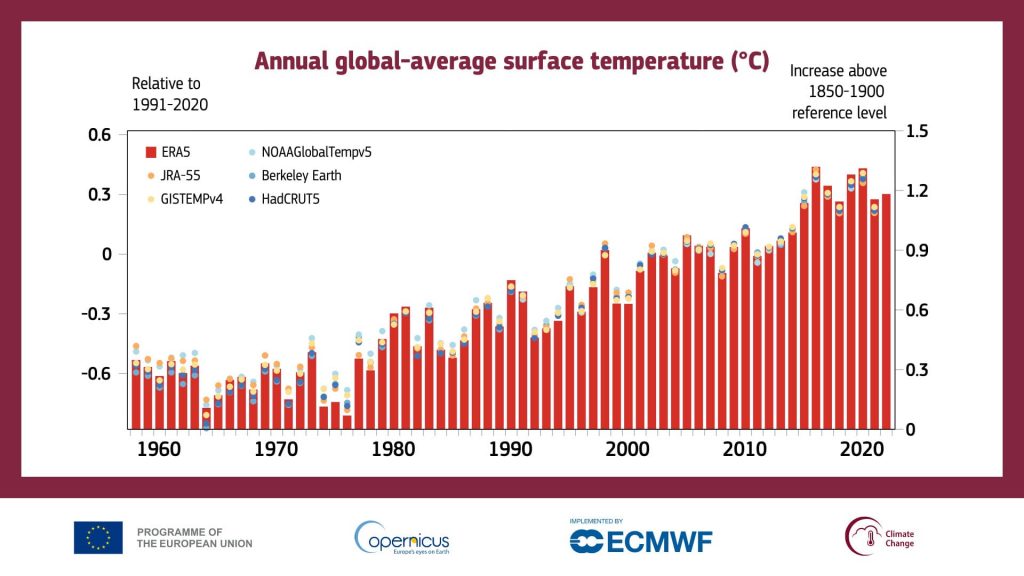 Change in mean annual temperature comparedfrom 1991-2020 (left scale) and pre-industrial era (right scale) according to various climate observation services. Image: Copernicus Climate Change Service, ECMWF
Compared to the base period (averagetemperature for 1991-2020), which is used for the assessment under the Paris climate agreements, the global average temperature rose by 0.3 °C in 2022. At the same time, in several regions of northern and central Siberia and along the Antarctic coast, it changed much more significantly: more than 2 °C higher than the baseline.
At the same time, in some regions it was the warmest year.throughout the history of observations. Among them are most of Western Europe, parts of the Middle East, Central Asia, China and New Zealand. At the same time, it was the second hottest year for Europe as a whole. It was slightly behind 2020, although the summer months still set a record and were the hottest since 1850.
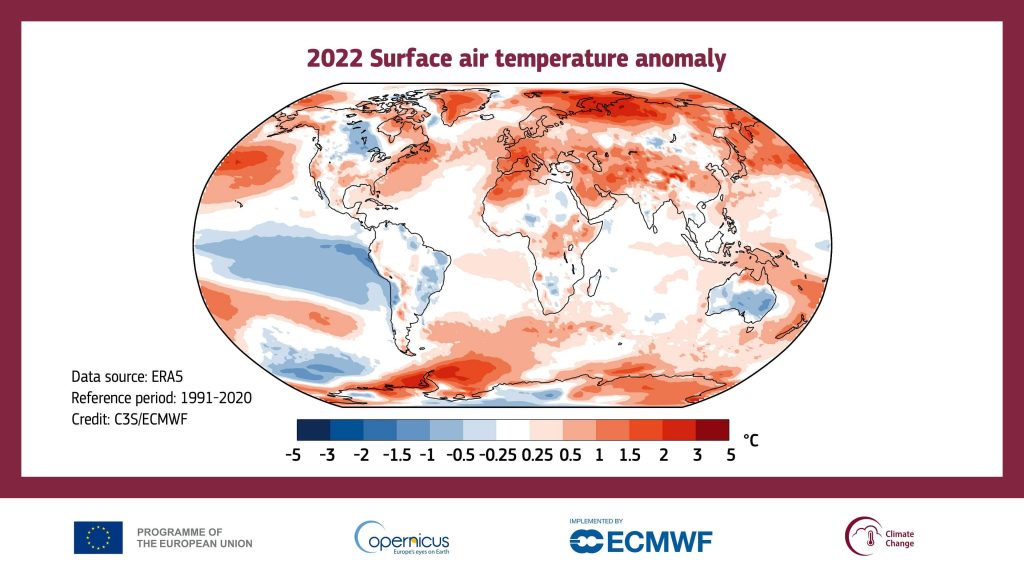 Comparison of mean annual temperature in 2022 and in the base period 1991–2020. Image: C3S, ECMWF
climate anomalies
2022 was marked by severaltemperature records and climate change. This was especially pronounced in the Antarctic regions, where the changes are most noticeable due to extremely low base temperatures. So, according to climatologists, both in the Arctic and in Antarctica in March 2022 there was an intense warm period with temperatures well above average.
For example, at Vostok station in EasternIn Antarctica, recorded temperatures hit -17.7°C, the highest recorded in the 65-year history of observations. And at the Antarctic station Concordia, located at an altitude of 3234 meters above sea level, on March 18 the temperature reached -12.2 ° C, which is 40 ° C higher than the average and an absolute record for 40 years of observations. At the same time, temperature records were observed in the Arctic: the temperature on some days exceeded the norm by 30 °C.
In addition, during the year researchersrecorded an unusually low state of sea ice in Antarctica, and in the second half of February, sea ice extent on the icy continent reached an all-time low, surpassing the previous minimum in 2017.
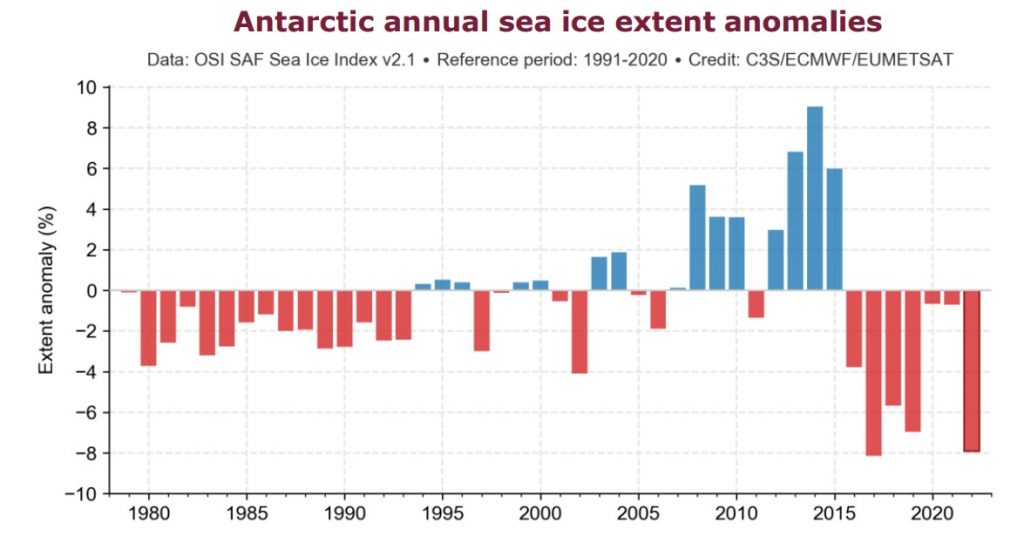 Change in Antarctic ice extent from the 1991–2020 base period. Image: C3S, ECMWF, EUMETSAT
At the same time, otherextreme weather events: record droughts in some regions and floods in others. Thus, in central and eastern China, prolonged heat waves were observed in the summer, followed by a drought, as a result of which the river, which provides water for a third of China, became record-breaking shallow. And Pakistan experienced record rainfall, leading to large-scale flooding across much of the country and causing widespread destruction and loss of life.
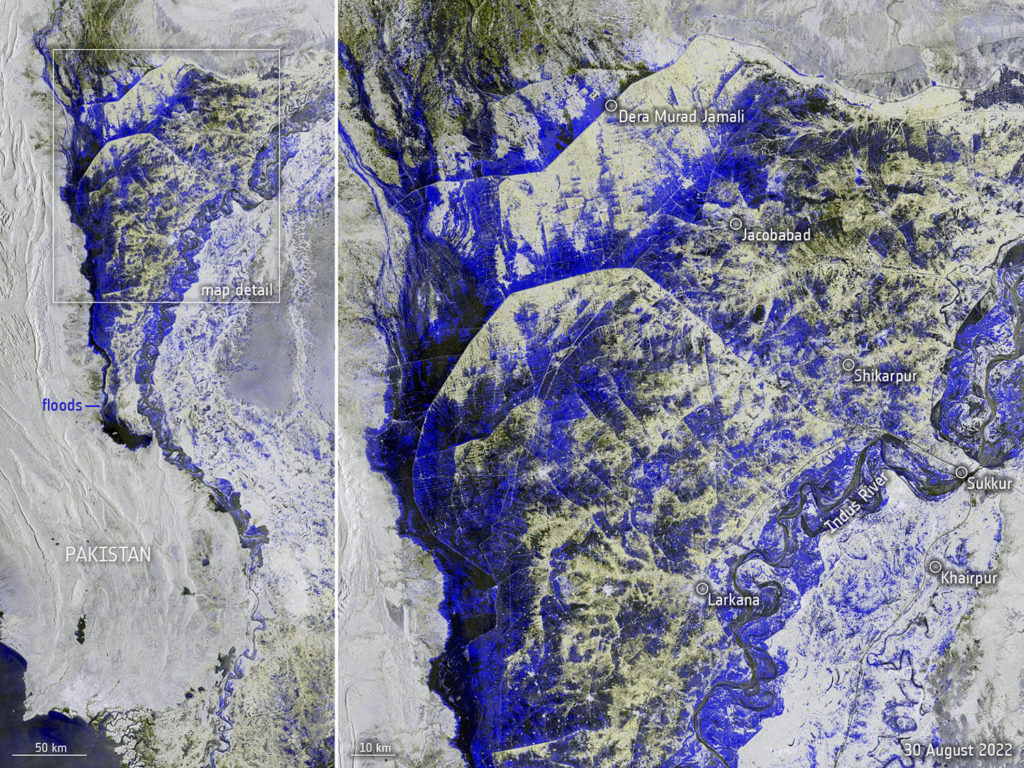 Satellite flooding in Pakistan. Image: Copernicus Sentinel data (2022), processed by ESA, CC BY-SA 3.0 IGO
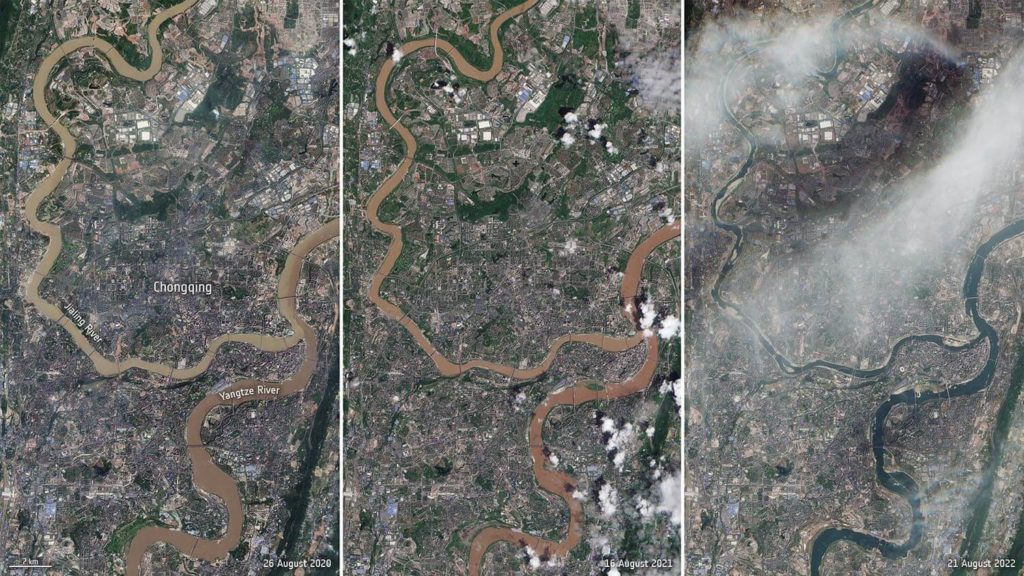 Change in water level in the Yangtze during a drought in China from the satellite. Image: Copernicus Sentinel data (2022), processed by ESA, CC BY-SA 3.0 IGO
Record greenhouse gas emissions
Another record was recorded by meteorological satellitesthe amount of greenhouse gases in the atmosphere. Preliminary analysis by Copernicus experts shows that carbon dioxide concentrations across the entire atmosphere increased by about 2.1 parts per million in 2022, and methane concentrations by about 12 parts per billion.
The average annual value was approximately 417ppm for carbon dioxide and 1894 ppb for methane. At the same time, for both gases, these are the maximum values in the entire history of satellite observations. And the analysis of other sources suggests that the concentration of carbon dioxide did not reach such high values for more than 2 million years, and methane - 800 thousand years.
Changes in the concentration of carbon dioxide and methane in the atmosphere. Animation: C3S, ECMWF
The researchers note that although the reductiongreenhouse gas emissions was one of the goals of both the Kyoto Protocol and the Paris Climate Agreement, so far it can be said that success along this path has not been achieved. At the same time, according to experts from the Copernicus climate service, the results of climate change are already manifesting themselves in the form of various anomalies that bring enormous destruction and lead to death.
Read more:
The strongest class X flare occurred on the Sun
"Anti-cancer sponge" stopped the spread of metastases in 100% of cases
The secret of the durability of Roman concrete is revealed: it can be restored