In a new study, NASA scientists have confirmed that the speed of sound on Mars and Earth is very
How does sound work?
When we hear sound, we actually feelvibration of the eardrums. It appears due to pressure waves that reach the ears of a person from a sound source. To overcome this distance, some medium is needed, for example, air. Sound waves can travel through liquids and even solids, but the ideal medium is air.
What is the difference between sound on Mars and on Earth?
Mars has a very unusual atmosphere compared to Earth, with a different temperature, density and chemical composition. These differences affect some audio metrics, such as:
Volume
Sound levels on Mars will be much lower.All due to the fact that the atmosphere of the Red Planet is about 100 times more rarefied than the earth's. Its density is about 0.020 kg/m3, compared to 1.2 kg/m3 on our planet, a new study has found.
This affects how sound wavespropagate from the source to the detector, resulting in a softer signal. On Mars, a person needs to be much closer to the sound source in order to hear it at the same volume level as on Earth.
Quality
The atmosphere of Mars is 96% carbon dioxide.gas and absorbs a lot of high-pitched sounds, so only lower-pitched sounds would travel long distances. This effect is known as attenuation - the weakening of the signal at certain frequencies. The farther a person is from the source, the more noticeable this effect.
Speed
The sounds made in the cold Martianatmosphere will take a little longer to reach the ear. With an average surface temperature of about –63 °C, the speed of sound on Mars is about 240 m/s. Scientists have already proven this in a new study. These results were announced at the 53rd Lunar and Planetary Science Conference by planetary scientist Baptiste Chide of Los Alamos National Laboratory. For comparison, the speed of sound on Earth is approximately 340 m/s on Earth.
Scientists used the Perseverance instrumentSuperCam, which blasts rocks with lasers to study Martian geology. By measuring the time it took for the staccato clicks to reach the SuperCam microphone, they determined the speed of sound on Mars to within plus or minus 0.51%.
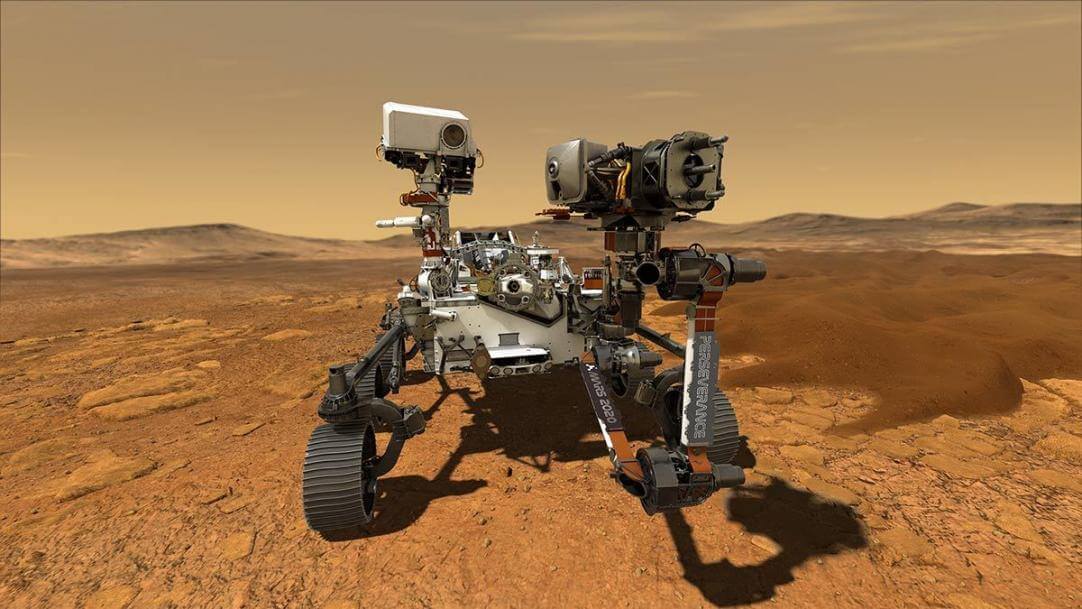 perseverance. Photo: NASA
Scientists also found that the speed of sound withfrequency below 240 Hz dropped to 230 m/s. This does not happen on Earth because sounds in the audible frequency range (20 Hz to 20 kHz) travel at a constant speed. "Martian idiosyncrasy," as scientists call it, is associated with "the unique properties of carbon dioxide molecules at low pressure." This makes the Martian atmosphere the only one in the solar system that affects the change in the speed of sound right in the middle of the audible range, the scientists write.
This acoustic effect will causea person will hear high sounds before bass. Below 240 Hz, there is a lot of acoustic information, including the low frequencies of music and the lowest registers of the human (usually male) voice. Music on Mars would sound completely erratic (especially with increasing distance). If you add a dampening effect or dampening of the high frequencies, the acoustic experience becomes even stranger.
What does a voice sound like on Mars?
Together these three factors will change the soundhuman voice in the atmosphere of Mars. However, it is worth considering that the atmosphere of Mars itself is unsuitable for human life, and they will have to wear spacesuits and use radio communications.
However, as part of the popularization of the mission of PerseveranceNASA has shared a special tool that distorts the sound of a person and makes it clear how it would sound on Mars. Hear how the voice sounds on Earth and Mars.
Read more
Scientists have named the first sign by which to look for extraterrestrial life
Potentially dangerous asteroid will approach Earth on April Fools' Day
Genetics Beat Cat Allergies With CRISPR